


Board Composition in 2026: Why Only 32% of Executives Trust Their Board's Skill Mix

Executive Summary
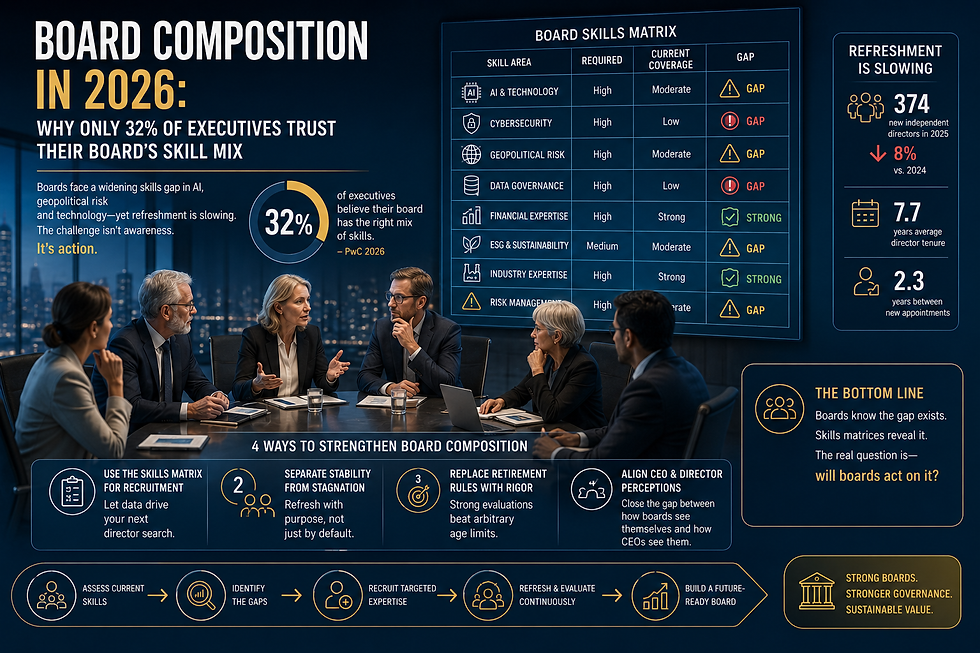
Here's a number worth sitting with: only 32% of executives believe their board actually has the right mix of skills to oversee AI, geopolitical volatility, and shifting trade policy, according to PwC's 2026 research. That's not a fringe complaint from a handful of frustrated CEOs. That's roughly two out of every three executives looking at their own board and quietly concluding the people meant to provide strategic oversight aren't fully equipped for the risks actually on the table right now.
What makes this genuinely strange is what's happening on the other side of the equation at the exact same time. Board refreshment, the natural mechanism that would fix a skills gap like this, has slowed down rather than sped up. Average tenure is climbing. New director appointments dropped to their lowest level in nearly a decade. Boards facing an acknowledged skills mismatch are, on the whole, becoming more stable, not less, which is either a sign of careful, deliberate governance or a slow-motion mismatch between what boards need and what boards are actually doing about it, depending on which company you're looking at.
This post walks through the actual numbers behind that tension, why refreshment has stalled even as the skills gap gets louder, and what boards serious about closing it are actually doing differently.
Quick Answer Section
What is board composition?
Board composition is the mix of skills, experience, expertise, independence and perspectives represented on a company's board. In 2026, boards are facing growing pressure to ensure their composition reflects emerging priorities such as AI, cybersecurity, geopolitical risk, technology and changing trade policies.
How big is the board skills gap right now?
Significant. Only 32% of executives say their board has the right expertise mix for today's priorities, per PwC's 2026 board research, and separate data shows only 43% of CEOs believe their directors have subject-matter expertise aligned with the company's most pressing issues.
Is board refreshment speeding up to fix this?
No, it's slowing. S&P 500 boards appointed 374 new independent directors in 2025, an 8% drop and the lowest figure since 2016, with average board tenure now sitting around 7.7 years.
Why would boards slow refreshment during an acknowledged skills gap?
Largely a preference for stability during a genuinely volatile period, boards have leaned toward directors with prior board experience rather than new capability, prioritizing calm over fresh expertise.
What's a skills matrix, and is it helping?
A structured chart mapping each director's expertise against what the board actually needs. Adoption has nearly doubled in a few years, but having the matrix and acting on what it reveals are two different things.
Who feels this gap most acutely?
CEOs and executives more than directors themselves, several surveys show a real perception gap where directors rate their own preparedness considerably higher than the executives reporting to them do.
Example Board Skills Matrix
Skill Area | Required | Current Coverage | Gap |
Financial expertise | High | Strong | Low |
AI & technology | High | Moderate | Medium |
Cybersecurity | High | Low | High |
Geopolitical risk | High | Moderate | Medium |
ESG | Medium | Strong | Low |
Industry expertise | High | Strong | Low |
International markets | Medium | Moderate | Medium |
Then explain:
The purpose of a board skills matrix is not simply to disclose existing expertise. Its real value is identifying the capabilities the board needs next.
The Gap Nobody's Hiding, Exactly, But Nobody's Closing Either
PwC's research isn't the only place this shows up, and that's part of what makes it credible rather than a single outlier stat. A separate CEO survey found that just 43% of CEOs believe their board directors carry subject-matter expertise genuinely aligned with the company's most pressing issues, right now, this year. Ask directors the same question about themselves, and 63% say yes. That twenty-point gap between how CEOs see their board and how boards see themselves isn't a rounding error. It's a genuine disagreement about whether the room has what it needs, and the people running the company day to day are considerably less convinced than the people overseeing them.
Layer onto that PwC's finding that only 35% of executives rate their board's overall effectiveness as excellent or good, and a pattern starts to firm up. This isn't one bad survey question. It's a consistent signal, across multiple independent research efforts, that a meaningful share of the executive population looks at their board and doesn't fully trust what's there.
Why Refreshment Slowed Down at the Exact Wrong Moment
Here's the part that should genuinely surprise people. Given a documented, widely acknowledged skills gap, you'd expect boards to be refreshing faster, bringing in new expertise to close it. The opposite happened.
S&P 500 boards appointed 374 new independent directors in 2025, an 8% decline from the year before and the lowest total since 2016. Average annual turnover now sits at less than one new director per board per year. Average board tenure has climbed to 7.7 years, and new appointments themselves happen only once every 2.3 years on average, meaning most boards aren't refreshing annually even in principle. The demographic shift backs this up from another angle too: the share of directors aged 66 to 70 has risen noticeably across both the Russell 3000 and S&P 500 over the past several years, while the youngest cohort of directors has shrunk as a share of the total.
Why would boards choose stability over fresh capability during exactly the period they admit they need new capability most? The honest answer, based on how boards themselves describe it, is that volatility bred a preference for proven, calm hands over untested new ones. Nearly three-quarters of Fortune 500 board seats filled in 2025 went to people who already had prior public board experience, the second-highest share in over a decade of tracking. Boards facing genuine uncertainty, economic, geopolitical, technological, chose familiarity and composure over the specific new skill sets that same uncertainty was actually calling for. That's a defensible instinct in the short term. It's also precisely how a documented skills gap sits unresolved for years rather than one or two board cycles.
Board Composition vs Board Refreshment
Board Composition | Board Refreshment |
Who is currently on the board | How board membership evolves |
Measures existing capabilities | Addresses future capability needs |
Skills and experience | Recruitment and succession |
Current governance structure | Ongoing board renewal |
Identifies gaps | Helps close gaps |
The Mandatory Retirement Policy Quietly Disappearing
There's a structural piece of this worth understanding, because it's not just about who boards choose to appoint, it's about the guardrails boards have been dismantling around when directors have to leave. Between 2020 and 2025, the share of S&P 500 companies with no mandatory age-based retirement policy at all rose from 31% to 39%. Over the same period, companies that still maintain a mandatory retirement policy declined from 35% down to 26%. The pattern isn't unique to large caps either, the broader Russell 3000 shows the same direction, just starting from an even higher baseline of flexibility.
This isn't necessarily bad governance by itself. There's a genuine, credible research case that longer cumulative board tenure correlates with stronger institutional knowledge and better decision-making up to a point, some analysis suggests board effectiveness may not meaningfully decline until tenure stretches well past a decade. But removing the automatic mechanism that used to force turnover, without a genuinely rigorous replacement process stepping in to do that job deliberately, is exactly how a board drifts into an unaddressed skills gap without anyone making an active decision to let that happen. Nobody chose to under-skill the board on AI oversight. The retirement policy that used to force the question just isn't asking it as often anymore.
Skills Matrices Are Everywhere Now. Are They Actually Changing Anything?
One place boards have genuinely moved is disclosure. The share of S&P 500 proxy statements including a formal director skills matrix, a structured chart mapping each director's expertise against the board's actual needs, nearly doubled in just four years, reaching 73% by 2024. That's a real and fast shift toward transparency about where gaps sit.
But a skills matrix is a diagnostic tool, not a treatment. It tells a board, and its shareholders, exactly where the gaps are. It does nothing on its own to close them. The honest test isn't whether a board has a skills matrix, plenty do now. It's whether that matrix actually drives the next director search, or whether it gets published in the proxy each year, technically accurate, and then quietly ignored when the actual recruiting decision gets made in favor of, once again, someone with prior board experience and a calm reputation.
Regional Context: This Gap Isn't Unique to the US
It's worth noting this isn't a US-specific phenomenon, even if the sharpest recent data comes from American boards. Governance research across Asia found a strikingly similar shape to the problem: nearly seven in ten governance leaders identified digital technology skills as a critical board development need, yet only about three in ten had actually mandated director training on AI, and a similar minority had recruited directors with specific AI expertise. The acknowledgment of the gap and the action to close it are running on separate, mismatched timelines almost everywhere boards are being surveyed right now, not just in one market.
A Boardroom Perspective
The uncomfortable truth in all of this is that acknowledging a skills gap and closing one are entirely different acts, and most of the current data shows boards doing a lot more of the former than the latter. A board that can accurately name its own gap in a skills matrix but doesn't let that finding drive its next actual director search hasn't solved anything. It's just gotten better at describing the problem it isn't fixing.
A Practical Framework for Closing the Composition Gap
Four steps boards can take that don't require waiting for the next full board cycle to turn over naturally:
Let the skills matrix actually drive recruiting, not just disclosure.
If the matrix says AI or geopolitical expertise is missing, the next search should be built around that finding specifically, not general "board experience."
Separate stability from stagnation deliberately.
Valuing experienced, calm directors is reasonable. Treating that preference as a permanent substitute for targeted new expertise is how a gap becomes structural.
Replace lapsed retirement policies with real assessment discipline.
If a board has moved away from mandatory retirement ages, the annual evaluation process needs to be doing real, honest work instead, not becoming a formality.
Ask CEOs and directors the same question, separately.
The gap between how executives and directors each rate board readiness is itself useful data. If it's wide, that disagreement deserves a direct conversation, not an assumption that directors know best.
Real-World Example
A mid-sized industrial manufacturer's board had, on paper, done everything right. A published skills matrix. An annual evaluation process. A stated commitment to overseeing the company's growing AI-driven supply chain forecasting. When a board seat opened up after a long-serving director's retirement, the matrix clearly flagged AI and data governance as the board's single biggest gap. The search committee reviewed several candidates with exactly that background, then ultimately selected a retired CFO from a similar-sized industrial company instead, someone with deep operational credibility and prior public board experience, but no particular AI or technology background.
The reasoning wasn't unreasonable in isolation, the board was navigating a leadership transition and wanted continuity during a genuinely uncertain year. But the documented gap the matrix had identified remained exactly where it started, publicly disclosed, accurately described, and structurally unaddressed for at least another full board cycle. The diagnostic tool worked perfectly. The decision it was supposed to inform went a different direction anyway.
Board Skills Gap: Problem vs Solution
Problem | Board-Level Solution |
AI expertise gap | Recruit or develop AI expertise |
Long director tenure | Strengthen succession planning |
Skills matrix not used | Link matrix directly to recruitment |
Retirement policy removed | Strengthen annual evaluations |
CEO-director perception gap | Compare assessments |
Geopolitical risk expertise gap | Add relevant experience |
Cybersecurity gap | Add technology/cyber expertise |
FAQs
What percentage of executives think their board has the right skills for today's risks?
Only 32%, according to PwC's 2026 board research, covering AI, geopolitical volatility, and trade policy oversight specifically.
Is board refreshment increasing to address this gap?
No, it's slowing. S&P 500 boards appointed the fewest new independent directors since 2016 in 2025, and average tenure continues to rise.
What's a director skills matrix?
A structured disclosure, now included in most S&P 500 proxy statements, mapping each director's expertise areas against what the board's strategic priorities actually require.
Do CEOs and directors agree on whether the board has the right expertise?
Not really. Separate research found only 43% of CEOs believe their directors have relevant subject-matter expertise, compared with 63% of directors who believe the same about themselves.
Why are mandatory retirement policies becoming less common?
Boards are shifting toward more flexible, judgment-based composition decisions rather than automatic age-based turnover, though this requires a genuinely rigorous assessment process to work well in practice.
What is a board skills matrix?
A board skills matrix is a structured assessment that maps each director's expertise against the skills and experience the board needs to oversee its strategic priorities.
Key Insights for Directors and Boards
Only 32% of executives believe their board has the right skill mix for AI, geopolitical, and trade-policy oversight, and a similar CEO-versus-director perception gap shows up in separate research.
S&P 500 board refreshment hit its lowest level since 2016 in 2025, even as the skills gap became more widely acknowledged.
Mandatory retirement policies have declined sharply since 2020, removing a structural mechanism that used to force turnover automatically.
Skills matrix disclosure nearly doubled in four years, but a matrix identifying a gap doesn't guarantee the next recruiting decision actually closes it.
The pattern isn't US-specific, similar gaps between acknowledged need and actual action on AI expertise show up in board research across Asia as well.
What Should Boards Ask About Their Composition?
What skills does our strategy require over the next three to five years?
Which of those skills are currently missing?
Does our board skills matrix reflect future needs or only current directors?
Is AI expertise sufficient for our business?
Do we have adequate cybersecurity and data expertise?
Can our directors effectively oversee geopolitical risks?
Is director tenure affecting board renewal?
Does our succession planning address identified skills gaps?
Are CEO and director assessments of board effectiveness aligned?
Does our next director search directly address an identified gap?
Key Takeaways
The board composition problem in 2026 isn't a mystery hiding in the data, it's sitting in plain sight, disclosed in skills matrices and confirmed across multiple independent surveys. What's missing isn't awareness. It's the follow-through that turns an accurately diagnosed gap into an actual recruiting decision, rather than a comfortable choice for continuity dressed up as prudence. Boards that close this gap in the next cycle will be the ones willing to let their own skills matrix outrank their instinct for a familiar, steady hand, and right now, most of the data suggests that's still the harder choice to make.
Directors’ Institute – World Council of Directors can help you strengthen your board journey by developing your understanding of director roles, responsibilities, corporate governance, and effective boardroom leadership.
Join our exclusive webinar: Directors-Institute-webinar-registration


Comments