


How Should Independent Directors Manage Governance Risks? Insights from Directors’ Institute

There's a moment that tends to repeat itself across boardrooms — across companies, sectors and even countries. An independent director asks a fairly simple question — "Who prepared this data and did anyone outside the finance team verify it?" — and the room goes quiet for a second longer than it should. Nobody has a clean answer ready. That pause tells us more about the state of governance risk than any compliance report ever could.
This is the thing about governance risk — it rarely announces itself. It doesn't show up as a fraud alert or a regulatory notice on day one. It shows up as small pauses, unasked questions, decks that look a little too polished and directors who nod along because pushing back feels socially awkward in a room they were personally invited into. By the time it becomes a headline, the independent director who could have flagged it six months earlier usually already sensed something was off. We've heard this exact regret from directors after the fact, more times than we'd like.
So the real question isn't whether independent directors care about governance risk. Most do. The real question is whether they know how to actually manage it — not just react to it after the fact, but build habits, systems and instincts that catch it early. That's what we want to unpack here. Practical, a little candid about where boards typically fall short and hopefully useful whether you're sitting on a board right now, running a family business trying to figure out why your independent directors seem so passive, or a CXO quietly hoping for a board seat of your own someday.
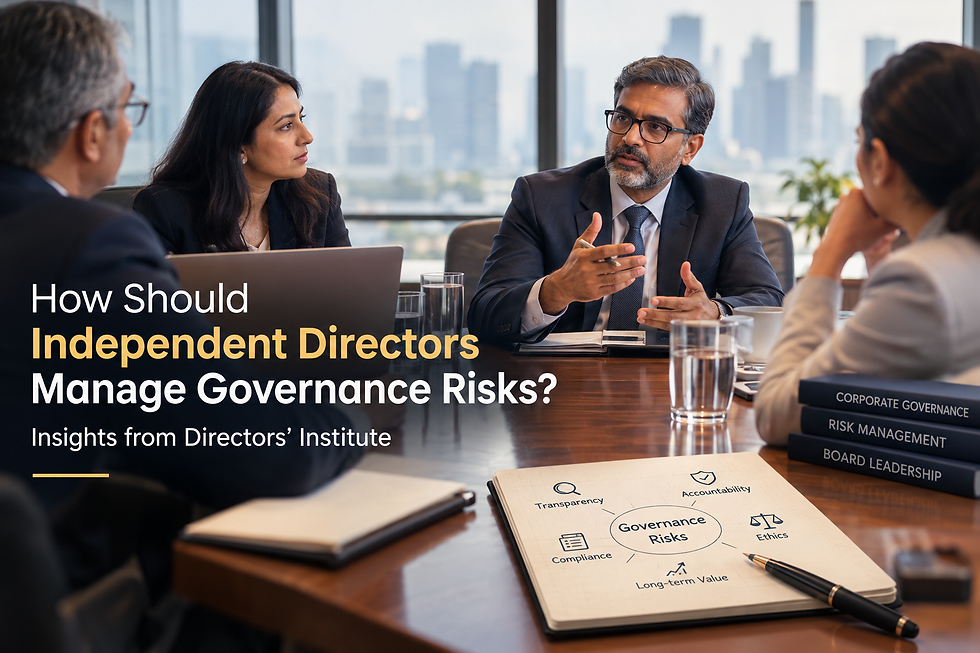
What "Governance Risk" Actually Means for an Independent Director
Let's get one confusion out of the way first, because we see it conflated constantly. Governance risk is not the same as operational risk or financial risk, though all three tend to get lumped together in board presentations under one tidy "risk" tab.
Operational risk is about whether the business runs well — supply chains, technology, people, execution. Financial risk is about numbers — liquidity, leverage, market exposure, working capital. Governance risk is different and in our view, it's the one that gets the least deliberate attention despite carrying the most personal exposure for directors. It's about whether the decision-making process itself is sound. Is the board getting complete information, or a curated version of it? Is dissent genuinely welcome, or just tolerated on paper because it looks good in the minutes? Are related-party transactions getting real scrutiny, or a rubber stamp because questioning them feels awkward? Is there a culture where someone can say "I don't think this is right" without it quietly costing them their seat at the next AGM?
Independent directors are uniquely exposed here and we don't think this gets said enough in boardroom conversations. When something goes wrong operationally, the CEO and the operating team carry the weight of it. When something goes wrong governance-wise, it's the independent directors' names on record, their signatures on the minutes, their professional reputations tied to the outcome — often for years afterward. Regulators globally are increasingly holding independent directors personally accountable, not just the company as an entity and we're watching this trend accelerate rather than slow down. That changes the calculus entirely. An independent director isn't just there to advise anymore. They're there to actively manage risk, or they're exposed right alongside everyone else in the room.
The Governance Risks Every Independent Director Should Be Watching
Not all governance risks look the same and honestly, some are far sneakier than others. Based on what we consistently see across boardrooms, here are the ones we'd put at the top of the list.
1. Information Asymmetry
This is the quiet one and arguably the most persistent. Management controls what gets into the board pack, how it's framed and what gets left out entirely. It's rarely malicious — most executives aren't trying to hide anything sinister. But there's a natural, very human tendency to present things in the best possible light, to smooth over the messy bits before they reach the board. An independent director who only ever sees curated dashboards is, in a very real sense, governing blind, no matter how many meetings they attend.
2. Groupthink and a Weak Dissent Culture
Boards that have worked together for years develop rhythms — and rhythms can quietly turn into echo chambers. When disagreement starts to feel like disruption rather than diligence, that's a red flag we take seriously. We've seen boards where the same two or three voices dominate every meeting and everyone else simply agrees, sometimes out of genuine consensus, but often out of fatigue or social pressure. That's not governance. That's theatre wearing governance's clothes.
3. Related-Party Transactions and Promoter Overreach
This one is especially relevant in family-run businesses and promoter-heavy cap tables, which make up a significant share of the boards we engage with. Related-party deals aren't inherently wrong — many are entirely legitimate and value-accretive. But they require a level of scrutiny that's easy to skip when the promoter is also the person who nominated you to the board in the first place. Independent, in name, has to mean independent in practice, especially here, or the entire designation becomes a formality.
4. ESG and Regulatory Drift
ESG disclosure requirements are shifting faster than most boards can keep pace with and regulators aren't waiting for companies to catch up. What was "nice to have" three years ago is becoming a hard legal requirement now and the directors who treated ESG as a marketing exercise rather than a governance obligation are the ones scrambling today. We'd argue this is one of the fastest-moving risk categories in the boardroom right now and it's often under-resourced relative to how quickly it's evolving.
5. Succession and Continuity Risk
This is the risk nobody wants to discuss because it feels premature, even a little morbid, to talk about "what happens if the CEO leaves tomorrow." But boards without a documented succession plan are gambling with continuity and independent directors are often the only voice in the room without a personal or political stake in delaying that conversation indefinitely.
6. Cybersecurity and Data Governance Oversight Gaps
Increasingly, we're seeing this treated as purely a management-level, IT-department problem — when in fact board-level oversight of cyber risk is becoming a genuine governance expectation, not an operational afterthought. A data breach today isn't just an operational failure; it's a governance failure if the board never asked the right questions about preparedness in the first place.
How Independent Directors Can Proactively Manage These Risks
This is the part that actually matters to us — not just spotting risk, but doing something about it before it becomes a crisis. Here's what we've seen work consistently and what we'd genuinely recommend to any director serious about this role.
Build Your Own Information Channels
Don't wait for the board pack to tell you what's happening. Talk to the CFO outside of formal board meetings. Ask to sit in on an internal audit briefing once a quarter. Request direct access to whistleblower reports, including the ones that got "resolved" quietly before they ever reached the board. This isn't about distrust — it's about not outsourcing your judgment entirely to someone else's summary. In our view, a director who only reads what's handed to them isn't functionally independent, regardless of what their appointment letter says.
Ask the Uncomfortable Question Early
There's a principle we come back to often in our conversations with directors: the best time to ask an uncomfortable question is before it's uncomfortable to ask. Once a deal is mid-negotiation or a number has already been announced publicly, raising concerns feels like sabotage. Raise them earlier, when it's still just a discussion and it becomes diligence instead of disruption. Practically, this means reading the board pack before the meeting — not skimming it in the car on the way there — and walking in with two or three pointed questions already drafted, not improvised on the spot.
Strengthen Committee-Level Scrutiny
Audit committees, risk committees and nomination committees exist precisely because full-board discussions often don't have the bandwidth for deep dives. If you're on one of these committees, we'd urge you to treat it as seriously as any executive responsibility — this is where governance risk actually gets caught or quietly missed. Push for committee meetings to run longer than the default 45 minutes if the agenda genuinely needs it. Don't let committee reports to the full board become a two-line summary that erases all the nuance of the actual discussion that happened in the room.
Document Dissent and Rationale
This one is partly self-protective and partly good governance in its purest form. If you disagree with a decision, say so on record and make sure it's captured properly in the minutes — not just "Director X expressed reservations," but the actual substance of what was flagged and why. This matters for two reasons. First, it protects you personally if things go wrong later and questions are asked about who knew what, when. Second and more importantly to us, it creates a paper trail that forces the board to actually engage with dissent rather than let it evaporate into a vague, forgettable footnote.
Commit to Continuous Self-Education on Regulatory Shifts
Governance norms are not static and we say this to every director we work with. What was compliant last year might not be this year, particularly around ESG disclosures, data privacy obligations and related-party transaction thresholds. The directors we respect most treat this like ongoing education, not a box checked once when they first joined a board. Set aside a few hours a month, genuinely, for this. It's less glamorous than strategy discussions, but it's often the difference between catching a regulatory shift early and finding out about it via an enforcement notice.
Push for Structured Risk Reporting, Not Just Narrative Updates
We'd also add this: insist on risk being presented to the board in a structured, trackable format — heat maps, trend lines, red-amber-green status over time — rather than a verbal narrative update each quarter that's hard to compare against the last one. Structured reporting makes patterns visible. Narrative updates, however articulate, tend to hide them.
A Word for Promoters and Family Business Owners
If you're a promoter reading this, we want to say something directly to you: empowering your independent directors is not a threat to your control, it's insurance for it.
We understand the instinct to keep the board close, to bring in independent directors who are unlikely to rock the boat, especially in family businesses where trust and legacy run generations deep. But this is exactly the pattern that tends to backfire — sometimes years later, when a governance lapse that could've been caught early turns into a regulatory problem, a succession dispute, or a reputational crisis that hits the family name directly, not just the company's balance sheet.
The resistance we encounter most often isn't hostility, it's discomfort. Promoters aren't used to being questioned by people they personally brought onto the board. But a genuinely independent director who pushes back occasionally is doing exactly what they were appointed to do. If every board meeting is smooth and unanimous, that's not necessarily a sign of good governance. In our experience, it's often a sign that nobody in the room is really independent at all.
For CXOs Aspiring to Board Roles — What to Learn Now
If you're a CXO with an eye on a future board seat, or eventually the CEO chair, here's something worth internalizing early and something we'd want every aspiring director to hear before they get their first seat: the skills that make you excellent operationally are not automatically the skills that make you a good governor.
Operating executives are trained to move fast, make calls and drive execution. Board-level governance requires a different muscle — the ability to step back, ask probing questions without having all the operational context in hand and sit with ambiguity a little longer than feels natural in an executive role. Start practicing this now, in your current position. When you're in leadership meetings, notice who's asking the governance-style questions — the ones about process, oversight and long-term risk rather than just quarterly execution — and try being that person occasionally, even if it's not technically your lane. It's a different kind of leadership than the one that got you promoted this far and the earlier you start building it, the more board-ready you'll genuinely be, not just on paper or on a résumé.
Where We See Boardroom Governance Heading
We'll close on a more forward-looking note, because we think it matters for anyone planning their next few years in a boardroom.
Governance is shifting from a periodic exercise to a continuous one. Real-time risk dashboards, AI-assisted anomaly detection in financial reporting and predictive compliance tools are already changing what "board oversight" looks like in practice. Directors who once reviewed quarterly summaries are increasingly expected to engage with live data and we expect that expectation to intensify rather than ease. The boards that adapt early, that build genuine comfort with these tools rather than treating them as an IT department's problem, are going to have a real advantage in catching governance risk before it metastasizes into something public.
At the same time, personal liability for independent directors is trending upward globally, not down. Regulators are less inclined to treat "I wasn't fully informed" as a valid defense — the expectation is shifting firmly toward directors actively seeking out information, not passively receiving it. That's uncomfortable for a lot of people who took board seats expecting a lighter, advisory-style role. But we'd argue it's ultimately a healthy shift. It forces the title "independent director" to actually mean something in practice, rather than being an honorary line on a company letterhead.
We also expect board evaluations themselves to get more rigorous — less about ticking a box once a year and more about ongoing, structured feedback on whether individual directors are actually adding governance value, not just attending meetings and staying quiet.
Final Thoughts
Managing governance risk isn't about being the difficult person in the room. It's about being the person who asks the question early enough that it never has to become a difficult conversation later. It's a quieter, less glamorous form of leadership than the one most executives are trained for — but in our experience, it's the one that actually protects companies, boards and the individuals sitting in those boardroom chairs.
If you're an independent director reading this and something in here made you slightly uncomfortable, good. That discomfort is usually where the real work of governance actually starts.
FAQs
What is the biggest governance risk independent directors face today?
Information asymmetry tends to top the list — directors making decisions based on curated, management-filtered data rather than independently verified information.
How can independent directors protect themselves legally?
Documenting dissent clearly in board minutes, building independent information channels outside of management reporting and staying current on regulatory obligations are the most practical safeguards.
Why do family businesses struggle with independent director effectiveness?
Often because independent directors are personally selected by promoters, creating an implicit reluctance to challenge decisions, even when genuine scrutiny is warranted.
Is governance risk increasing for independent directors?
Yes — regulatory trends globally are shifting toward greater personal accountability for independent directors, making proactive risk management more critical than ever.


Comments