


Shadow AI Is Now a Legal Problem: Why Regulators Want Proof, Not Policies, in 2026

Executive Summary
A few years back, if a regulator asked a company about its AI oversight, a nicely worded policy document and an ethics statement on the website would usually get you through the conversation. That's genuinely not true anymore, and it's not true because of one single dramatic law. It's true because a handful of state-level regulators in the US, along with EU enforcers, started asking a much more annoying question this year: prove it.
The thing forcing that question is shadow AI, the sprawling, mostly invisible layer of AI tools employees are already using that nobody in compliance signed off on. It's less a hacking problem and more a "everyone quietly solved their own problem the fastest way they could" problem, and it's turned into one of the defining compliance headaches of 2026.
This post walks through what shadow AI actually looks like inside a real company, why regulators shifted from accepting policy statements to demanding technical evidence, and where the US state law landscape, Colorado, California, New York, actually stands right now, not where a lot of outdated blog posts still think it stands.
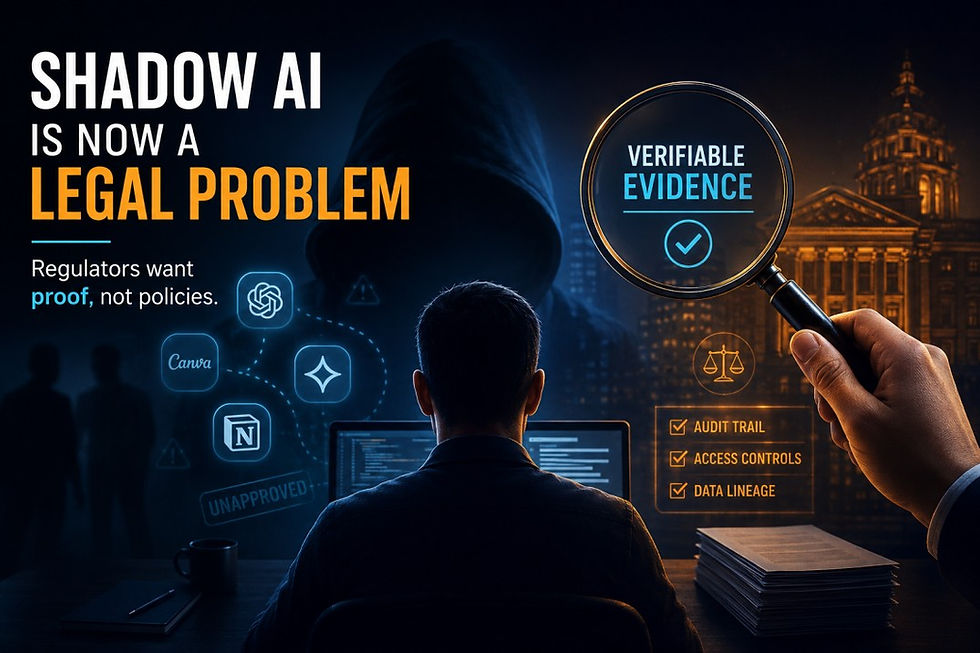
Quick Answer Section
What is shadow AI?
Shadow AI refers to AI tools, models or AI-powered features used within an organization without formal approval, security review or centralized governance. It can include standalone AI applications as well as AI features embedded in approved business software.
Why do regulators want technical evidence now instead of policies?
Because a written policy proves intent, not behavior. Regulators want to see audit logs, data lineage records, and access controls that prove the policy was actually followed, not just written down.
What's the current status of Colorado's AI law?
It changed significantly in 2026. The original Colorado AI Act never actually took effect, it was repealed and replaced by a narrower law, SB 26-189, whose real obligations begin January 1, 2027.
What's happening in California and New York?
California has moved fastest and furthest, with multiple laws already in force through 2026. New York's RAISE Act is signed and headed toward a 2027 effective date.
Who's exposed to this risk?
Almost every company of meaningful size. Surveys this year put the share of employees using unapproved AI tools well above a third, and some estimates run much higher.
Policy vs Evidence: What's the Difference?
Policy | Evidence |
States what should happen | Shows what happened |
Defines expectations | Demonstrates implementation |
Shows intent | Shows behavior |
May be static | Can be continuously updated |
Describes controls | Demonstrates controls |
Useful for governance | Useful for audits and investigations |
Key takeaway: A policy establishes intent. Evidence demonstrates execution.
What Shadow AI Actually Looks Like (It's Rarely Malicious)
Here's the thing people get wrong about shadow AI first: it's almost never someone sneaking around trying to cause harm. It's an engineer pasting a chunk of proprietary code into a public model to debug it faster. It's a marketing team using a free AI writing tool because the procurement process for an approved one takes six weeks. It's a feature that quietly activated inside software the company already uses, Notion, Slack, Microsoft 365, without anyone in IT clicking "approve" because there was nothing to approve, it just showed up in an update.
That last category matters more than people realize. Employees increasingly aren't going around the approved software stack at all. They're using AI features baked directly into tools they were already cleared to use, which makes the whole thing far harder to spot with a standard software audit. Recent industry surveys put the share of workers using AI tools their employer hasn't sanctioned somewhere above a third, with a notable chunk admitting they've shared confidential or sensitive information with those tools without their employer knowing. That's not a hypothetical risk sitting in a slide deck. That's happening in most companies, right now, whether leadership realizes it or not.
Why "We Have a Policy" Stopped Being a Good Enough Answer
For a long time, the compliance conversation went roughly like this: does your company have an AI use policy, has it been communicated, is there training. Answer yes to those and you were mostly fine.
That's shifted hard in 2026, and it's worth understanding why. A policy tells a regulator what you intended to happen. It says nothing about what actually happened. And once shadow AI became widely acknowledged as a real, common phenomenon rather than an edge case, regulators stopped taking intent as a proxy for behavior. What they're asking for now looks a lot more specific: a complete inventory of every AI tool in use, including embedded features inside already-approved software. Documentation showing which tools touch regulated data, and whether the right data processing agreements exist for each one. Evidence of employee training, with actual dates, not just a policy that says training happens. And increasingly, logs, network traffic records, proxy data, anything that shows the organization was actively watching for unauthorized AI use rather than just hoping it wasn't happening.
That last point is the real shift. The audit question used to be "do you have a control." Now it's closer to "prove the control worked, and show me the evidence trail." A written ethics policy without an underlying system that can reconstruct what actually happened is, in a regulator's eyes now, functionally close to having no policy at all.
The US State Law Picture, Corrected for What's Actually True Right Now
This is where I want to slow down, because a lot of coverage on this topic is quietly out of date, repeating a version of Colorado's law that no longer exists.
Colorado passed the country's most comprehensive state AI law back in 2024, targeting high-risk systems used in consequential decisions like employment, housing, healthcare, and insurance. It required risk management programs and consumer disclosures. Here's the part that trips people up: that law never actually took effect. It got delayed once, then in May 2026 Colorado repealed and replaced it entirely with a narrower law, SB 26-189, focused on automated decision-making technology. The real obligations under that replacement don't begin until January 1, 2027. If you've read a blog post describing Colorado's "current" AI Act requirements dated before mid-2026, there's a decent chance it's describing a law that was already scrapped by the time you read it.
California has moved the fastest of any state, by a wide margin, and it's done it through several overlapping laws rather than one. SB 53, the Transparency in Frontier AI Act, took effect January 1, 2026, and applies to developers of the largest frontier models, requiring published risk frameworks, safety incident reporting to the state attorney general within a tight window, and whistleblower protections. AB 2013 took effect the same day, requiring developers of generative AI systems to publish summaries of their training data. SB 942, covering disclosure when content has been AI-generated or modified, arrives in August 2026. Taken together, California isn't waiting for one comprehensive law, it's building the same evidentiary expectations through a stack of narrower, faster-moving statutes.
New York's RAISE Act was signed at the end of 2025 and is on track for a 2027 effective date, following a similar path to Colorado in terms of timing, though its substance leans more toward frontier-model safety obligations. It's not live yet, but it's real, and it's coming.
The pattern across all three states, regardless of exact timing, points the same direction: consumer disclosure, documented risk assessment, and a paper trail that can survive scrutiny after the fact, not before.
What Counts as Verifiable AI Governance Evidence?
Depending on the organization's AI environment, evidence may include:
AI application inventory
AI vendor records
Access logs
Network traffic records
SaaS usage data
Data lineage
Data-processing agreements
AI risk assessments
Employee training records
Approval documentation
AI incident records
Model monitoring records
Governance committee minutes
Corrective-action records
Why This Genuinely Isn't Just an EU Problem Anymore
It's tempting to file all of this under "the EU AI Act's documentation requirements," and treat US developments as a side note. That's a mistake. The EU AI Act's August 2026 enforcement date and the US state law wave are running on separate tracks, driven by separate regulators, and a company operating in both markets now has genuinely overlapping but not identical evidence obligations. Shadow AI doesn't respect that jurisdictional line either. An unauthorized AI tool touching EU customer data and a US employee's personal information at the same time creates exposure under both regimes simultaneously, and the evidence a company would need to defend itself looks remarkably similar either way: an accurate inventory, documented data flows, and a record of who was actually watching.
A Boardroom Perspective
The uncomfortable truth for most boards right now is that the biggest AI risk sitting inside their organization probably isn't the AI system leadership approved and rolled out with fanfare. It's the dozen smaller tools nobody formally signed off on, quietly running inside teams that just wanted to move faster. Asking "do we have an AI policy" is the wrong question at this point. The better one is: if a regulator walked in tomorrow and asked for our complete AI tool inventory, including every embedded feature inside software we already use, could we actually produce it within a day, or would it take weeks of digging first?
A Practical Framework for Getting Ahead of This
Four steps worth treating as immediate priorities rather than a future project:
Run a real discovery pass, not a survey. Ask departments what AI tools they use and you'll get an incomplete, well-meaning answer. Pull actual network, proxy, or SaaS access data to find what's genuinely running.
Map data flows before you map policy. Know which tools touch regulated or sensitive data first. That's where the legal exposure concentrates, and it's where regulators will look first too.
Treat embedded AI features as seriously as standalone tools. An AI assistant baked into software you already approved is not automatically safe just because the parent software went through procurement.
Keep the evidence, not just the intention. Training dates, access logs, and documented decisions about what you chose not to fix yet, all of it matters more than a clean-looking policy PDF.
Real-World Example
A mid-sized healthcare administrative company assumed its AI exposure was limited to one clinical decision-support tool it had formally vetted, tested, and documented carefully over eighteen months. During a routine vendor security review tied to a new contract, an auditor asked for a full inventory of AI touching patient scheduling and billing data. It turned out three separate departments were using AI features embedded in customer service and document-processing software that had been live for over a year, none of it flagged in any prior review, because none of it had ever been a distinct "purchase" anyone tracked. The formally approved tool the company had spent so much effort governing wasn't the risk. The unremarkable software updates nobody thought to re-examine were.
FAQs
Is shadow AI illegal by itself?
Not automatically, but it becomes a serious regulatory problem when it touches regulated data without proper agreements, disclosures, or oversight, and when the organization can't show it took reasonable steps to prevent or detect it.
Does Colorado still have an active AI law right now?
The original 2024 Colorado AI Act never took effect and was repealed. Its replacement, SB 26-189, is signed but its substantive obligations don't begin until January 1, 2027.
Which US state AI law is currently the most demanding?
California, by volume and by how much is already in force. Between SB 53, AB 2013, and SB 942, multiple obligations are live or arriving within 2026 rather than waiting for a future date.
What counts as "verifiable technical evidence" to a regulator?
Things like audit logs, access records, data lineage documentation, dated training records, and network or SaaS usage data, artifacts that show what actually happened, not just a policy describing what should happen.
Can embedded AI features inside approved software count as shadow AI?
Yes, and increasingly this is the most common form of it. Employees don't need to seek out an unapproved tool if an AI feature simply activates inside software already sitting on their desktop.
How can companies detect Shadow AI?
Companies can combine employee awareness programs with technical discovery methods such as network traffic analysis, proxy data, SaaS usage records, access logs and AI application inventories.
Why aren't AI policies enough?
An AI policy establishes what employees are supposed to do, but technical evidence can help demonstrate what actually happened and whether the controls were followed.
What evidence can demonstrate AI compliance?
Evidence may include: AI tool inventories, Access logs, Network records, Data lineage, Training records, Approval records, Risk assessments, Incident reports, Monitoring records
Key Insights
Shadow AI is usually a productivity workaround, not misconduct, but regulators judge organizations on impact and evidence, not intent.
The compliance bar has moved from "do you have a policy" to "prove the policy actually worked," backed by logs and documented records.
Colorado's original AI Act never took effect and was replaced; its real obligations don't start until January 1, 2027, a detail a lot of current content still gets wrong.
California is the fastest-moving state, with multiple distinct laws already live rather than one comprehensive statute pending.
Embedded AI features inside already-approved software are becoming the dominant form of shadow AI, harder to spot than standalone unauthorized tools.
Key Takeaways
The message underneath all of this is simple, even if the regulatory map is messy: a policy document is no longer proof of anything on its own. What regulators, and increasingly insurers and auditors, actually want is evidence that the policy was followed, that someone was watching, and that the organization can reconstruct what happened after the fact rather than guessing. Companies that treat AI governance as paperwork are going to keep discovering, usually during a review they didn't expect, that their real AI footprint looks nothing like what they thought they'd approved.
Directors’ Institute – World Council of Directors can help you strengthen your board journey by developing your understanding of director roles, responsibilities, corporate governance, and effective boardroom leadership.
Join our exclusive webinar: Directors-Institute-webinar-registration


Comments