


Why Companies Need a Chief Data, Analytics and AI Officer in the Age of AI

Introduction
The AI Race Has a Leadership Problem Nobody Is Talking About
The meeting had been going for forty minutes. The CEO was asking a simple question — "What does our AI strategy actually look like across the business?" — and the room had gone quiet in that particular way rooms go quiet when nobody wants to be the first to admit they don't have a clean answer.
The CTO spoke about infrastructure. The CDO spoke about data pipelines. The head of digital spoke about three pilot projects. Nobody spoke about strategy. Nobody could, because nobody owned it.
This scenario — and I've seen versions of it more times than I'd like to admit — is playing out in boardrooms and leadership meetings across industries right now. Companies are spending millions on AI tools, AI pilots, AI consultants. But the one thing most of them haven't done is appoint someone whose entire mandate is to make AI work as a unified, governed, business-driving force.
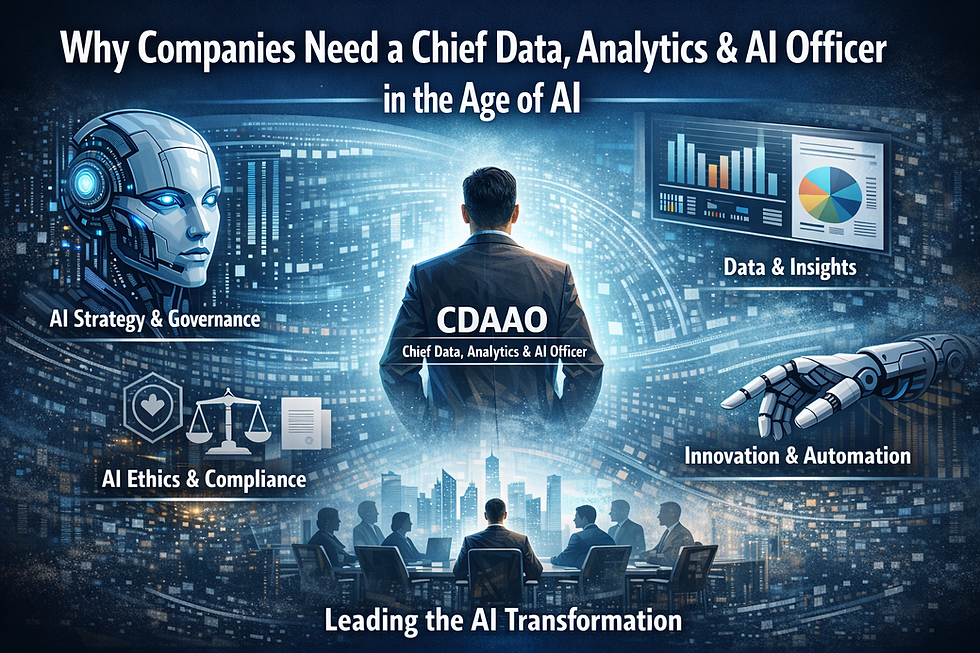
That person has a title now. Chief Data, Analytics and AI Officer — CDAAO. And if your organisation doesn't have one, or hasn't seriously asked whether it needs one, that silence is itself a strategic decision — just not a deliberate one.
This blog is written for CXOs who are thinking seriously about the CEO role — or already operating at that level of strategic accountability. Because the question of AI leadership is not a technology question anymore. It is a business architecture question. And it sits squarely in the lap of whoever is serious about leading a future-ready enterprise.
The Role That Didn't Exist — Then Suddenly Did
From CDO to CDAAO — How the Role Evolved With the Stakes
To understand why the CDAAO matters, you need to trace how we got here — because the evolution of this role tells you something important about how enterprise priorities have shifted.
It started with the Chief Data Officer. Organisations recognised, somewhere around 2010–2015, that data was accumulating faster than anyone could make sense of it. The CDO was appointed to bring order — governance, quality, and infrastructure. It was largely an internal-facing, compliance-adjacent role. Important, but not exactly sitting at the strategy table.
Then came the analytics wave. Suddenly data wasn't just something to manage — it was something to mine. The role expanded. Chief Data and Analytics Officer became the more common title. The mandate grew to include generating insight from data, building analytics capability and influencing business decisions with evidence rather than instinct. Better. More strategic. Still, in many organisations, treated as a support function.
And then AI arrived — not as a future possibility but as a present operational reality. Generative AI, machine learning at scale, agentic systems making autonomous decisions. The stakes changed entirely. Because now we weren't talking about dashboards and reports. We were talking about AI systems interacting with customers, influencing pricing, driving hiring decisions, shaping clinical outcomes. The governance requirements alone became enormous.
The companies that separated these functions — a CDO here, an AI centre of excellence there, a data science team embedded in business units — are discovering a painful truth: fragmentation is the enemy of AI value. Without unified leadership, data stays siloed, AI models get built without consistent governance and analytics insights never quite make it into the decisions that matter.
The CDAAO role exists to close that gap. And for CXOs watching this space, understanding why it exists is the first step to knowing what to do about it.
What a Chief Data, Analytics and AI Officer (CDAAO) Actually Does
Beyond the Buzzword — The Real Mandate
This is where conversations about the CDAAO role tend to get vague — which is frustrating, because the actual mandate is quite specific. Let me break it down plainly.
First: owning the data-to-decision pipeline, end to end.
A CDAAO is accountable for the full journey — from how data is captured and stored, to how it's cleaned and governed, to how analytics surfaces insight from it, to how AI acts on that insight. In most organisations today, this journey crosses three or four different teams with three or four different reporting lines. The CDAAO unifies that. Not by controlling everything — but by owning the integrity of the pipeline and the quality of the output.
Second: setting and enforcing AI governance frameworks.
This is the part that most boards and CEOs underestimate. AI governance is not about restricting what AI can do. It is about ensuring that what AI does is accurate, fair, explainable and aligned with the organisation's values and regulatory obligations. Who decides which AI models get deployed? Who reviews them for bias? Who is accountable when an AI-driven decision causes harm — to a customer, an employee, a partner?
Without a CDAAO, these questions have no clear owner. That's not a theoretical risk. That's a liability sitting quietly on your balance sheet.
Third: bridging business strategy and technical capability.
This is perhaps the most underappreciated part of the role — and the most relevant for CXOs. The CDAAO is the translator. On one side, you have business leaders who know what outcomes they need but don't speak data. On the other, you have data scientists and AI engineers who can build extraordinary things but don't always understand the business context they're building for. The CDAAO bridges that gap — fluent in both languages, accountable to both sides.
Fourth: building an enterprise data culture.
Tools don't drive AI value. People do. A CDAAO's mandate includes shifting how an organisation relates to data — from treating it as a byproduct of operations to treating it as a strategic asset that requires investment, governance and active stewardship.
Why Boards and CEOs Keep Getting This Wrong
The Governance Gap at the Heart of Most AI Strategies
Let me say something that might be uncomfortable — the most common reason companies don't have a CDAAO is not budget. It's not even awareness. It's the assumption that someone else is already handling it.
In most organisations, that someone is the CIO or the CTO. And here is the problem with that assumption: the CIO's mandate is infrastructure and systems stability. The CTO's mandate is product and engineering. Both are essential roles. Neither is designed to own the strategic, governance-intensive, business-value-generating mandate of data, analytics and AI leadership.
When AI strategy is assigned to the CIO, it gets treated as a technology procurement question. Which tools to buy. Which cloud platform to use. What the integration looks like. These are legitimate questions — but they are not the strategic questions. The strategic questions are: What business decisions are we trying to improve with AI? What data assets do we have and what do we need? What governance frameworks ensure our AI is trustworthy? What ROI are we generating from our data investments?
Those questions need a different kind of leader.
The accountability vacuum that forms when data, analytics and AI have separate owners — or no dedicated owner — is where AI strategies go to die. Pilots get built that never scale. Dashboards get created that nobody uses. AI models get deployed without proper testing. And when something goes wrong — a biased model, a data breach, a regulatory challenge — the organisation scrambles to find who is responsible.
For boards, this is a governance failure. For CEOs, it is a strategic failure. And for CXOs who want to demonstrate CEO-level thinking, identifying and naming this vacuum — before being asked — is exactly the kind of strategic clarity that separates good executives from great ones.
The Business Case: What Changes When You Have a CDAAO
What Actually Happens When AI Leadership Is Centralised
Theory is useful. But let's talk about what actually shifts when an organisation appoints a CDAAO with the right mandate and the right access.
Decision-making gets faster and more confident.
When business leaders have a single, trusted source for data-driven insight — governed consistently, with clear methodology and connected directly to strategic priorities — the quality of executive decisions improves. Not because everyone suddenly becomes a data scientist, but because the data infrastructure is reliable enough to trust. That trust changes the speed and confidence of decisions at every level.
AI risk becomes manageable.
Hallucinations. Bias. Regulatory non-compliance. Reputational damage from AI failures. These are not abstract fears — they are documented outcomes from organisations that deployed AI without adequate governance. A CDAAO creates the oversight architecture that catches these risks before they become crises. Risk committees and audit committees can finally have someone in the room who both understands the technical exposure and can translate it into governance language.
Data becomes a balance sheet asset, not a basement storage problem.
Most organisations are sitting on data they don't fully understand, can't easily access and therefore can't leverage. A CDAAO treats data as an enterprise asset — inventoried, valued, governed and actively deployed to generate business value. For CXOs, this reframe matters: companies with strong data assets and the leadership to exploit them are increasingly valued at a premium by investors and acquirers.
Cross-functional AI initiatives actually land.
One of the most consistent failure modes in AI adoption is the proof-of-concept that never becomes production. Teams build impressive pilots, get excited and then the initiative stalls at the point of scaling — because it crosses organisational boundaries and nobody has the authority or the relationships to drive it through. A CDAAO with the right executive mandate and cross-functional relationships can do what individual business units cannot: drive AI value from pilot to enterprise scale.
The Boardroom Imperative: AI Governance Is Now a Fiduciary Duty
Independent Directors and CXOs — This Is Now Your Problem Too
There is a conversation happening in progressive boardrooms that hasn't yet reached most others — and it needs to.
AI governance is no longer a technical matter that boards can safely delegate to management and move on. It is a fiduciary matter. When AI systems make decisions that affect customers, employees, suppliers, or markets — and when those decisions carry regulatory, reputational and financial risk — the board is accountable for ensuring those systems are governed appropriately.
That accountability cannot be discharged without knowing who owns AI governance in the organisation. And that is precisely why the CDAAO's reporting line and board access matter so much.
In organisations where AI leadership is doing its job well, the CDAAO should have direct access to the board — or at minimum to a technology and risk committee — with a mandate to report on AI governance, data risk and the strategic health of the organisation's data and AI assets. Not once a year. Regularly. The same way the CFO reports on financial health.
For CXOs who sit on subsidiary boards, or who present to boards regularly, understanding this expectation is increasingly important. Boards will start asking more pointed questions about AI governance. The executives who can answer them — clearly, specifically, with evidence — will stand apart from those who offer vague reassurances about digital transformation roadmaps.
The regulatory dimension is also hardening. Globally, AI regulation is moving from principles to enforcement. The EU AI Act is already in effect. India is developing its own AI governance frameworks. Organisations that cannot demonstrate structured AI oversight — with clear leadership accountability — will face increasing scrutiny. For industries like financial services, healthcare and infrastructure, this scrutiny is already arriving.
The CDAAO is not just a strategic asset. It is a governance architecture. And for any CXO serious about enterprise leadership, understanding that distinction is essential.
Building for the CDAAO: What Organisations Actually Need to Put in Place
You Can't Just Hire a CDAAO and Call It Done
The CDAAO role succeeds or fails based on what surrounds it. And getting that infrastructure right is where strategic leadership — from the CEO and CXOs — becomes decisive.
Reporting line matters enormously. A CDAAO who reports to the CIO is, structurally, a technology function. A CDAAO who reports to the CEO — or has a dotted line to the board — is a strategic function. The reporting line communicates organisational priority more clearly than any job description. If you want AI and data to drive enterprise value, the CDAAO needs CEO proximity.
Cross-functional authority needs to be explicit. The CDAAO will inevitably need to make decisions that affect business units, technology teams and external partners. Without clearly defined authority — and CEO-level backing when that authority is tested — the CDAAO becomes an expensive advisor rather than an accountable leader. CXOs who have navigated cross-functional mandates will recognise this pattern immediately.
Data culture is a precondition, not an outcome. Organisations that treat data as an IT asset — something managed by the technology team — will hobble any CDAAO they appoint. The shift required is cultural: data as a shared enterprise resource, with business leaders as active stewards of data quality in their domains. Building that culture takes time and sustained leadership commitment from the top.
For promoter-led businesses and family enterprises, the CDAAO conversation often feels like a large-company problem. It isn't. If you are scaling, if you are dealing with increasing volumes of customer data, if you are deploying any form of AI in your operations — even basic recommendation engines or automated customer communications — you need someone with this mandate. It doesn't have to be a full C-suite hire immediately. But it has to be someone, with a clear brief, accountable to leadership.
What's Coming Next: The CDAAO in 2026 and Beyond
The Role Is Evolving Faster Than Most Organisations Can Hire For
Agentic AI changes the stakes dramatically. We are moving from AI that assists human decisions to AI that makes decisions autonomously — and acts on them. Agentic AI systems that can book, buy, negotiate and communicate on behalf of an organisation require a fundamentally different governance framework than AI that generates a report or drafts an email. The CDAAO of 2026 needs to govern systems that are, in a meaningful sense, acting as proxies for the organisation. The accountability implications are significant and largely uncharted.
The convergence of AI governance and corporate governance is accelerating. What was once treated as a technology compliance question is becoming a board-level governance question — about risk, accountability, ethics and enterprise value. The CDAAO is at the centre of that convergence. Organisations that have invested in this role will be dramatically better positioned to navigate the regulatory and governance expectations that are coming.
The CDAAO will become as standard as the CFO. This is not a dramatic prediction — it is a trajectory. Twenty years ago, the Chief Risk Officer was a specialist role found only in financial institutions. Today it is a standard expectation across industries. The same evolution is underway for AI and data leadership. The organisations that build this capability now will have years of institutional advantage over those that wait for it to become a regulatory requirement.
Conclusion
The Question Isn't Whether You Need a CDAAO. It's Whether You Can Afford Not to Have One.
Let's come back to that boardroom. The CEO asking about AI strategy. The silence before the fragmented answers from three different C-suite leaders. That moment — uncomfortable, expensive, avoidable — is what the CDAAO role is designed to prevent.
For CXOs who are building toward the CEO role, the lesson here is not just organisational. It is personal. Because the leader who walks into that room and says, "Here's how we fix this — here's the leadership architecture we need, here's what it delivers and here's what it costs us every quarter we don't have it" — that leader is demonstrating exactly the kind of enterprise clarity that gets people into the top seat.
AI is not coming. It is here. The governance deficit around it is real, measurable and growing. The CDAAO is not a luxury appointment for companies that have solved everything else. It is a foundational leadership decision for any enterprise that is serious about competing in an AI-shaped economy.
The companies that get this right — that invest in unified, governed, strategically connected AI leadership — will not just manage AI better. They will lead their industries. And the executives who drive that decision will be the ones that define what business leadership means in the years ahead.
Ask yourself honestly — if your CEO asked you tomorrow to outline your organisation's AI governance architecture, could you answer with confidence? Not in broad strokes. Specifically. With clarity on ownership, oversight, and what your board is actually being told. If there's even a moment of pause — that pause is your signal.
The leaders defining the next decade of Indian business are building that fluency now, not waiting for AI governance to become a board mandate. At Directors' Institute, that is precisely what we work on — with senior leaders and CXOs who refuse to be caught unprepared when the room goes quiet and the question lands on them.
Don’t let your AI strategy remain fragmented.
Join our upcoming webinar to understand how unified leadership, governance frameworks, and board-level oversight can transform AI into a true business advantage.
👉 Secure your spot today: https://www.directors-institute.com/webinar-registration




Comments