


AI Board Oversight in 2026: Why Boards Are Still Flying Blind

Executive Summary
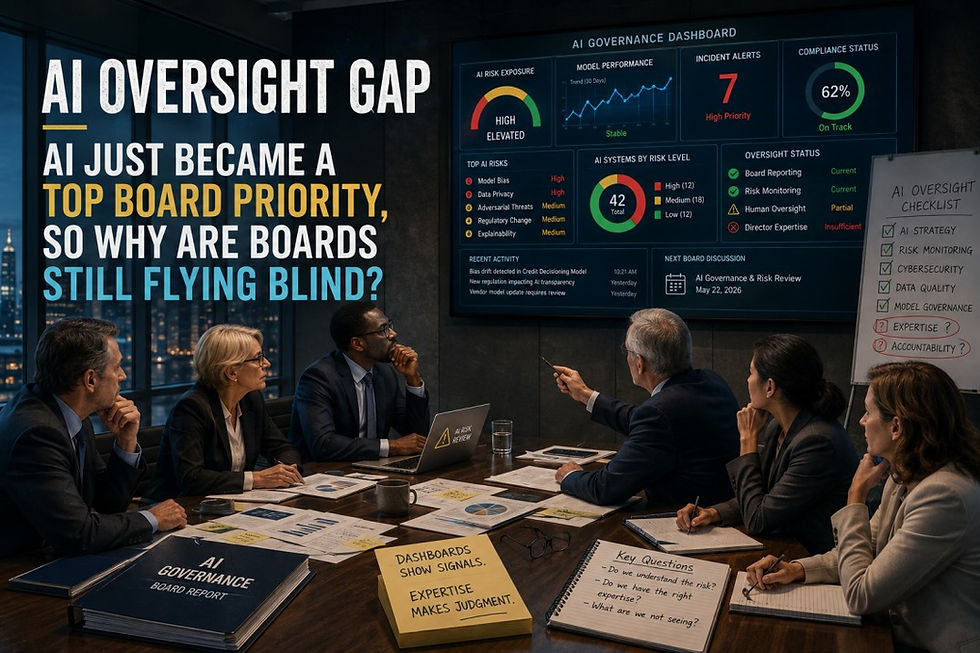
Something genuinely unusual happened to board agendas this year. AI didn't just show up as a topic, it climbed all the way to sit next to cybersecurity as one of the two things every serious board is now expected to actively oversee, not just discuss once a year in a slide deck nobody reads twice. Boards responded the way boards usually respond to a new priority: they bought tools. AI-powered governance dashboards, real-time risk platforms, scenario-planning software with AI baked in, adoption of all of it has genuinely accelerated.
Here's the uncomfortable part, and it's the part most coverage glosses over. The tools arrived faster than the expertise did. Multiple surveys this year, run by different firms, using different methodologies, all land on roughly the same uncomfortable conclusion: boards are buying dashboards to oversee something a large share of directors still openly admit they don't fully understand.
This post looks at why AI overtook so many other board priorities so quickly, what these governance dashboards actually do, and the genuinely wide gap, backed by numbers that don't all agree with each other but do all point the same direction, between how seriously boards are treating AI and how equipped they actually are to oversee it.
Quick Answer Section
What is AI board oversight?
AI board oversight is the process through which directors monitor and evaluate an organization's use of artificial intelligence, including AI-related risks, strategy, compliance, cybersecurity, governance controls and business impact.
Is AI really a top board oversight priority now?
Yes. Multiple 2026 director surveys rank deploying AI technology as either the top or second-highest organizational priority, on par with or just behind cybersecurity, which has been a fixture on board agendas for years.
What is an AI governance dashboard?
A real-time platform, often AI-powered itself, that pulls together risk data, compliance status, and performance metrics so directors can monitor an organization's exposure without waiting for a quarterly report.
Do boards actually understand the AI they're overseeing?
Not consistently. Several 2026 surveys found a majority of directors admit limited AI knowledge, and one widely cited study found fewer than 3% of S&P 500 board members have any disclosed AI expertise at all.
Why the gap between adoption and expertise?
Speed. AI adoption inside companies moved faster than board recruitment, training, and governance structures could realistically keep pace with.
Who should care about this gap?
Every stakeholder relying on board oversight to actually mean something, shareholders, regulators, employees, and frankly the directors themselves, given the liability exposure an unaddressed knowledge gap can create.
Why AI Oversight Is Becoming a Board-Level Risk
As AI becomes increasingly material to business operations and strategy, boards may face greater expectations to demonstrate that they have appropriate oversight processes. The governance question is therefore not simply whether directors understand AI, but whether the organization can demonstrate reasonable processes for identifying, monitoring and escalating material AI risks.
Why AI Suddenly Sits Next to Cybersecurity on the Board Agenda
Cybersecurity earned its permanent seat at the board table over roughly a decade, one high-profile breach at a time, until regulators and shareholders simply stopped accepting "we didn't know" as an answer. AI is compressing that same trajectory into a fraction of the time.
The numbers back this up in a way that's hard to argue with. Recent director surveys show US public company directors now ranking the deployment of AI technology as their second-highest organizational priority, and their single largest area of planned capital investment for the year. That's not a regional quirk either, directors across Asia-Pacific rank it in almost exactly the same position on their own priority lists. Meanwhile, regulators have quietly reinforced the parallel from the other direction. The SEC's 2026 examination priorities elevated both cybersecurity and AI concerns above cryptocurrency, which had dominated regulatory attention for the better part of five years. When a regulator's own priority list starts treating two things as equally urgent, boards tend to notice fast.
AI Governance Dashboard vs Board AI Expertise
AI Governance Dashboard | Board AI Expertise |
Provides data | Provides judgment |
Identifies anomalies | Interprets significance |
Monitors indicators | Challenges management |
Generates alerts | Determines appropriate response |
Tracks risk | Evaluates strategic impact |
Supports reporting | Supports governance decisions |
Key takeaway:
A dashboard can tell the board that something changed. Expertise helps the board understand what that change means.
What AI-Powered Governance Dashboards Actually Do
This is where the tooling conversation gets interesting, and slightly ironic. Boards facing a new oversight burden reached, understandably, for technology to help manage it, real-time governance dashboards that pull risk data, compliance status, and performance indicators into a single live view, rather than the old model of waiting for a quarterly board pack that was already stale by the time anyone read it.
Some of these platforms use AI themselves to flag anomalies, summarize risk trends, or surface items that need board attention before they'd otherwise surface in a formal report. In theory, that's exactly the shift governance needed, moving from periodic, backward-looking reporting toward something closer to continuous, forward-looking oversight. In practice, adoption has been broad but shallow. A recent director survey found the vast majority of boards have meaningfully changed how they approach scenario planning in just the past few years, expanding scope, spending more time on it, running more scenario types. And yet only a small fraction, roughly one in ten, are actually using AI tools to manage that added complexity. Everyone agrees the old way isn't sufficient anymore. Comparatively few have actually closed the gap with the new tools sitting right in front of them.

The Part Nobody Wants to Say Out Loud: Boards Don't Fully Understand What They're Overseeing
Here's where I want to be careful, because the data on this genuinely doesn't all agree, and pretending it does would be exactly the kind of sloppy research this piece is supposed to avoid.
One widely cited 2026 analysis from the Conference Board found that 83% of S&P 500 boards have formally identified AI as a material risk to their business, standard, sensible governance behavior. But when the same research looked at how many directors sitting on those boards actually had any disclosed AI expertise or credentials, the number came back at just 2.7%, nearly double what it was back in 2021, but still a strikingly thin bench for something 83% of boards are calling a material risk.
Other surveys paint a somewhat less dramatic, but still uneasy, picture. A global D&O liability survey this year found only about half of boards feel they have sufficient skills to provide effective AI oversight, making it one of the lowest-scoring competency areas out of more than a dozen assessed, trailing only climate risk. Separate research from Deloitte's Global Boardroom Program found two-thirds of boards still describe their own AI knowledge as limited to none, though that's actually a real improvement from roughly four out of five boards saying the same thing not long before. And a review of governance professionals found that while most boards have discussed AI in some form, only about a quarter have anything resembling formalized oversight, clear responsibilities, defined reporting lines, the structural backbone that turns "we talked about it" into actual governance.
Different methodologies, different sample sizes, genuinely different numbers. But notice they all describe the same shape: boards taking AI seriously as a risk category faster than they're building the expertise to actually evaluate it.
Why This Gap Exists, and It's Not About Effort
It would be easy to read all this as boards not caring enough, and that's not really what the data shows. Director confidence and director competence appear to be moving in opposite directions right now, which is its own kind of warning sign. One 2026 leadership survey found that board directors with the lowest actual confidence in their AI knowledge were, somewhat counterintuitively, the ones most likely to say their organization is moving too slowly on AI, while a separate share of CEOs directly said their boards lack an informed view of how AI reshapes growth strategy at all. Meanwhile the directors themselves, broadly, report feeling reasonably confident in their own AI fluency relative to their peers, a confidence level that sits somewhat uneasily next to how thin the actual expertise bench looks.
The honest explanation isn't laziness. It's speed mismatch. Recruiting a new director with genuine AI or technology expertise takes months, sometimes over a year, board seats don't turn over quickly, and only around one in ten boards report actually recruiting for that specific expertise so far. Structured AI-focused director education exists at only about half of boards. Compare that timeline to how fast generative AI and agentic systems have moved from experimental pilot to production reality inside the businesses those same boards oversee, and the mismatch stops being surprising. It becomes almost inevitable.
Why This Isn't Just an Awkward Statistic, It's a Real Liability Question
This gap matters beyond boardroom pride. Legal and insurance analysts have started drawing a direct line between a board's AI knowledge gap and its actual duty-of-care exposure. If a board can't demonstrate a reasonable understanding of the AI systems its own organization deploys, that's not just an embarrassing survey result, it's a documented governance weakness that plaintiffs' lawyers and regulators alike are increasingly positioned to point to after something goes wrong. And AI-related litigation has been picking up noticeably this year, which raises the stakes on closing this gap well beyond reputational discomfort.
A Boardroom Perspective
The uncomfortable truth sitting underneath all these surveys is that a governance dashboard is only as useful as the humans reading it. A beautifully built, AI-powered risk platform that surfaces the right alert at the right moment doesn't help much if the board looking at that alert doesn't have the fluency to ask the follow-up question that actually matters. The real oversight gap in 2026 isn't a lack of tools. It's a lack of the literacy needed to use the tools well, and that's a much slower problem to fix than buying software.
A Practical Framework for Closing the Gap
Four things worth prioritizing over the next board cycle, not the next multi-year strategic plan:
Measure real usage, not just sentiment. Ask how often the board's dashboard tools are actually consulted between meetings, not just whether directors say AI is important.
Recruit for the gap deliberately. With so few boards actively recruiting AI or technology expertise, this is one of the more direct levers available, and one of the most underused.
Fund structured director education, not a one-off briefing. A single AI presentation to the board satisfies a checkbox. It doesn't build fluency.
Separate confidence from competence, honestly. If directors report feeling confident about AI while independent assessments show a thin expertise bench, that gap itself deserves a frank board-level conversation.
Real-World Example
A mid-sized industrial company rolled out a new AI-powered governance dashboard early in 2026, proud of the shift from static quarterly reports to live risk monitoring. Within months, the system was correctly flagging an emerging AI vendor risk, a machine-learning tool used in supply chain forecasting that had started producing inconsistent outputs after an unannounced vendor update. The dashboard surfaced the anomaly clearly. What it couldn't do was help the board interpret what that anomaly actually meant for the business, because none of the directors present had the background to distinguish a minor calibration drift from a genuine, escalating problem. The alert sat in the board pack for a full cycle before anyone brought in outside technical expertise to properly assess it. The tool did its job. The oversight structure around it wasn't ready to use what the tool gave them.
FAQs
Is AI now considered as important as cybersecurity for board oversight?
In several 2026 director surveys, yes, they're increasingly treated as parallel top-tier priorities, reinforced by regulators elevating both above previously dominant concerns like cryptocurrency.
What's an example of an AI governance dashboard feature?
Real-time monitoring of risk indicators, automated flagging of anomalies or compliance gaps, and consolidated views of scenario planning data that used to require separate static reports.
How many board directors actually have AI expertise?
Estimates vary by survey, but one widely cited analysis found just 2.7% of S&P 500 directors have any disclosed AI expertise or credentials, despite the large majority of those same boards calling AI a material risk.
Why don't boards just recruit directors with AI backgrounds?
Some are starting to, but board turnover is slow, and only a small share of boards report actively recruiting for AI or technology expertise so far, a clear lag behind the urgency boards say they feel.
Does having a governance dashboard mean a board is actually overseeing AI well?
Not necessarily. A dashboard surfaces information; it doesn't build the fluency needed to interpret that information correctly, which several surveys suggest remains the bigger gap.
Key Insights
AI has climbed to sit alongside cybersecurity as a top board oversight priority, reflected in both director surveys and regulator examination priorities.
Governance dashboard adoption has grown quickly, but actual usage for complex tasks like scenario planning remains low, around one in ten boards, despite broad recognition that old methods fall short.
Expertise surveys genuinely disagree on the exact numbers, but consistently show a real gap between how seriously boards treat AI risk and how equipped directors feel to evaluate it.
Director confidence in AI knowledge doesn't reliably track with actual measured expertise, a mismatch worth boards examining honestly rather than assuming resolves itself.
The gap is increasingly framed as a legal and duty-of-care issue, not just a competence conversation, raising the stakes on closing it.
Key Takeaways
AI earning a seat next to cybersecurity on the board agenda is a genuine, measurable shift, not marketing language. But the tools boards have adopted to manage that new priority have outpaced the expertise needed to use them well, and multiple independent surveys this year, despite disagreeing on the exact numbers, all describe the same underlying gap. Closing it isn't primarily a technology problem. It's a recruitment, education, and honesty problem, and boards that treat a dashboard purchase as the finish line rather than the starting point are likely to discover, the way that industrial company did, that having the right alert isn't the same as knowing what to do with it.
Directors’ Institute – World Council of Directors can help you strengthen your board journey by developing your understanding of director roles, responsibilities, corporate governance, and effective boardroom leadership.
Join our exclusive webinar: Directors-Institute-webinar-registration


Comments