


From Influencer to Outlaw: How SEBI’s Ban and ₹546 Crore Impound Order Shook the Finfluencer World

What is a finfluencer under Indian law?
Is giving stock tips on WhatsApp or Telegram legal in India?
What triggered SEBI’s ban on finfluencers?
What is the difference between financial education and investment advice?
Do finfluencers need SEBI registration?
What penalties apply for unregistered investment advisory services?
Can SEBI impound money earned through illegal stock tips?
How can investors verify if a finfluencer is SEBI-registered?
Are social media platforms liable for finfluencer content?
What red flags should investors watch for in finfluencer content?
Day the ‘Market Guru’ Story Unravelled
Finfluencer economy in the Indian context operates in a very systematically dominated fashion, where the overriding theme that prevails is that of trust on a larger level. A reel, or a viral video, or an MMS broadcast does more in one day what perhaps the advisor cannot do in a year. It is basically the same reason that has caused this economy to be so sensitive if trust is distilled into a destructive form.
This is also the reason why the finfluencer ban mandated by SEBI on finfluencers Avadhut Dinkar Sathe, Gouri Avadhut Sathe, and Avadhut Sathe Trading Academy Pvt. Ltd. (ASTAPL) is nothing short of earth-shaking in itself. This ex parte interim order-cum-show cause notice dated the 4th Dec 2025, penned by SEBI, reads: "The activities are but a mere guise or cloak for a far more sinister act – Unregistered investment advisory and research analyst services offered through LIVE market interactions and paid forums."
“The headline number – Rs 546 Crore Impound – was an instant symbol of sorts. Not just of one instance, but of an entire turning point in terms of an attention-driven financial content economy in India.”
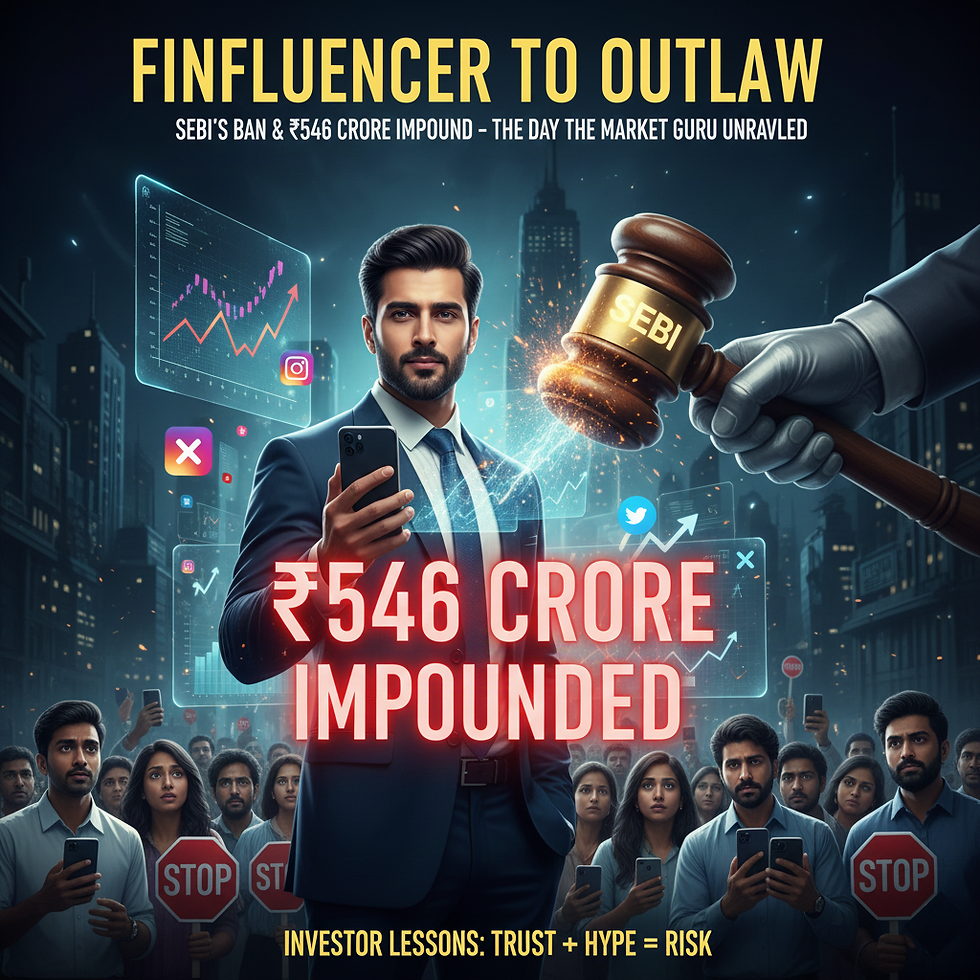
Claims brought by SEBI: "Education", which appeared to be advisory
Pursuant to the interim order passed by SEBI, the first assumption made by SEBI is that ASTAPL/Avadhut Sathe made no teaching related to concepts for what they are, but made stock-specific advice, such as targets, stop-loss, views, and trade-like advice in a manner similar to the advisory service, in their paid and/or group sessions.
One of the aspects which is relevant to the entire story for finfluencers: The content that was being disseminated by the concerned finfluencer on WhatsApp was classified by the SEBI depending upon the nature of the dissemination of that content. “Chart study” became a camouflage for trading recommendations for the WhatsApp setup that was charging fees.
“The distinction between education and advisories has existed in this twilight zone all along, where finfluencers function. Now, the finfluencer ban, which has been imposed by SEBI, is essentially where the regulator is beginning to demarcate this line with hard ink."
Fees, headcount, and the matter of the impounded ₹546 Crore
This renders the case substantial in nature, mainly due to the volume stated in the finding that has been made by SEBI:
The reported collection of fees:
The fees that have been collected are in excess of Rs. 600 crores with respect to 3.37 lakh investors/participants
The SEBI has directed the impoundment of an amount of ₹546.16 crores, which is prima facie an unauthorised gain.
There is a notable mention of the possible disgorgement of ₹601.38 crores, together with interest as relates to the total amount of the fees collected, and cases that are in motion.
In this context, it becomes relevant that when “₹546 Crore impound” expressed a value, it also expressed a statement by announcing, “When financial power gets monetised in terms of unregistered investment advice, the liability could get massive—and public.”
"The teardown of how the engine works is, in essence, this:"
In this case, the
Attention → community → Monetization
In other words, the Finfluencer Scandal shook the world because you have to think about the normal growth funnel:
The tools of trust at the upper funnel: YouTube, Instagram, Reels, and Testimonials.
Private conversion layer: groups – either Telegram groups or WhatsApp groups – and/or mentor groups/closed groups.
Premium pricing: Levels of mentorship, quality batches, live sessions.
Outcome Marketing and Return Screenshots: A Practice Under Scrutiny After the SEBI Finfluencer Ban
Here, the regulatory body at Sebi has cited private messages on a WhatsApp group, where market forecasts and individual stock recommendations are provided for the “premium mentorship batch priced up to a staggering cost of ₹6.75 lakh.”
SEBI had also raised objections on the matter of the misrepresentative promotion, where promotion relied on their remarkable performance, but in marketing, it relied on the profitable transactions.
It is here that unregistered investment advice passes from a mere non-compliance with the technical requirement into the domain of consumer protection.
Why Registration is significant and SEBI's eagerness regarding this.
It is easy to shout "registration" and all that jazz until one is confronted with what "registration" impacts. "Registration" impacts the guidelines of SEBI regarding investment advisers and research analysts because of the money-moving nature of the advice given.
The risk is much, much larger than somebody losing money. It’s mass behaviour based upon trust and hype about a person running a big paid community and influencing others to make trades.
This explains why the SEBI finfluencer regulation banning fininfluencers is newsworthy, as it suggests that SEBI is cognizant of the danger implicit in what passes for "advice-at-scale" that fininfluencers represent.
The question that comes to fore is what exactly SEBI ordered through the interim directions.
Consequently, the directions are therefore intended as a tool to effectively put a stop to the activity as well as preserve the assets pending the suit based on the interim order that has been issued by SEBI.
Contained some key elements including:
Restrictions on market access; Prohibition on buying/selling/dealing in securities until further orders, with limited exceptions like unwinding existing holdings.
In order to stop and desist from the business of providing Investment Advisory/Research Analyst services and other allied communications through the Website, Advertisement, Video, Brochure, Publishing on the Social Media, WhatsApp Groups, and other similar communications.
Instructions for depositing the amount of Rs. 546.16 crores into fixed deposits with lien indicated in favour of SEBI, and instructions to banks for not making any debits without prior approval from SEBI.
Guidelines regarding the preparation of the asset list, bank accounts, demat accounts, investments, and restrictions on fee collection for advisory services.
This was the combination of market restriction + communication restriction + asset control that made the news of the Impound of ₹546 Crore the turning point.
“Finfluencer” dilemma: Not necessarily a new situation, but certainly an inevitability
This matter is not an incident that just fell from heaven. SEBI has been hinting at the issue with the induction through the influence of the finfluencers, as well as the misleading information about the finfluencers. This is through consultation on how the regulators should treat the unregistered advice industry.
The trend is clear: the regulator is moving from being advisory and restrictive to being enforcement-like and limiting, particularly where a large amount of funds are being raised and where return of the claims fuels marketing.
Ripples: platforms, brands, and the meaning of credibility itself
1) Platforms turning up the heat
The effect of this has a huge impact on what follows next, which is how the platforms respond. The tighter the regulators squeeze the platforms, the tighter they will turn down the screw regarding advertising and the process of verification of advertisements. This will mean that there is less distribution of financial advertisements that are fraudulent and that merchandising "get rich" schemes will be hard.
2. Verification Pressure on Return Claims Is Greater
The second change of perception: The requirement for proven reporting of performances and an increased accountability of claims. Once again, this refers to the heart of what has come to be termed the “screenshot economy” and the potential for selective winning to spark off massive conversion to pay groups through this route.
3) The Brands and Intermediaries turn cautious
In addition to this, if a social influencer finds himself accused of running unregistered investment advisory concerns, partnerships or joint ventures might turn into quite delicate issues. The reputation damage associated with a brand and a broker can travel even quicker than any original content.
What it means for Investors: A Red Flag Checklist
As a retail investor trying to carve your path through the muddle of finfluencer content, the message is not "stay off the internet." The message is “update your filters."
"Advice masquerading as education" Warning signs that tend to recur in many situations:
Returns that are “guaranteed” or “unreal
Stock recommendations in paid groups, specifically entry/exit points, targets, stop loss
Pressure tactics are "join now," "only limited seats available," and "you'll miss the rally."
“Selective” testimonials, only screenshots of winnings (no transparency on the losses)
The rationalisation of expensive mentorship prices in terms of ‘Signals’ and ‘Secret Trades’
"Incident reports with a large number of students with outstanding returns"%
Too confident, but definitely: “This stock will go up tomorrow.”
SEBI finfluencer ban and impounding of ₹ 546 Crore is one such case that shows how easily the hysteria turns into a problem if a large number of people fall for such unauthenticated and unregulated advice.
What this means for the finfluencer: Planning and delivery as an art form are no longer sufficient
The reality remains that in the finance industry, reach has been faced with regulation.
Additionally, this does not mean that financial education should come to an end. This entails that:
Education must be concept-driven, and not stock-driven.
The disclosures should be unequivocal and uniform.
Return claims should be the truth; verifiable and regulated activities are required to adhere to the duly regulated parameters.
The larger picture: The finfluencer generation in India is growing up. Because finfluencing made investment accessible, it exploded. “For people who may never have been able to make an investment, they could now find investment information on their site, in a language they could understand, on a schedule they could follow.” But where there is no regulatory control, there emerges a different risk. “Where opinion prevails over discretion, risk emerges.” “The ₹546 Crore Impound case, and finfluencers being banned by SEBI, is a wake-up call in this industry.” This industry understands that trust is never a useful strategy unless it is coupled with a sense of responsibility.
Conclusion: How smart investors think in a noisy marketplace
Three things to retain from this experience, in my opinion, are these:
“If you are being paid money and told what trades to make, it should be regulated.”
“If it is marketing on ‘extraordinary returns,’ then prepare for ‘extraordinary risk.’”
“If it is hiding behind the cloak of ‘education,’ then there is no cause to worry.
It will likely fall under ‘Unregistered Investment Advisory’ since, in the wake of ₹546 Crore Impound, it is no longer a matter of whether it is inspirational, but a matter of being legal, secure, and safe.”
Our Directors’ Institute - World Council of Directors can help you accelerate your board journey by training you on your roles and responsibilities to be carried out efficiently, helping you make a significant contribution to the board and raise corporate governance standards within the organisation.




Comments