


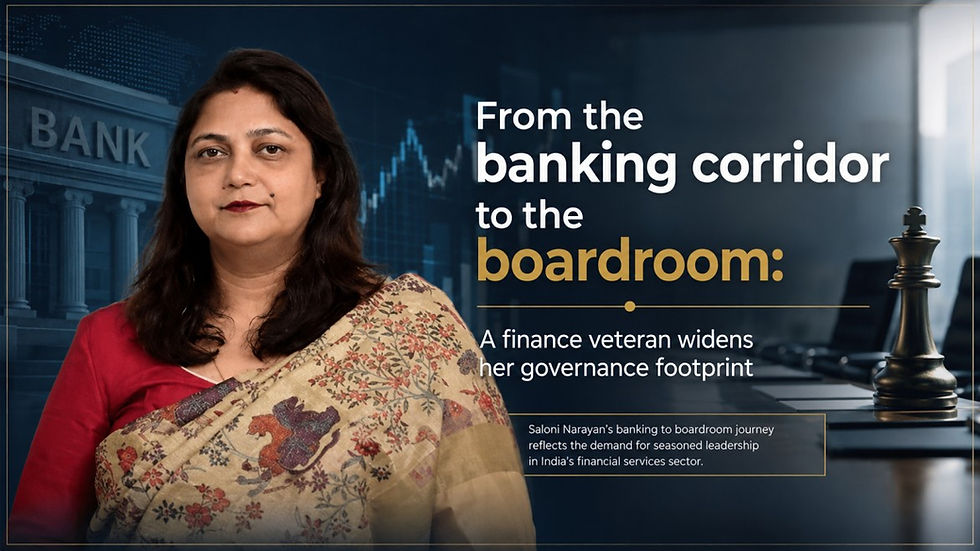
From the banking corridor to the boardroom: A finance veteran widens her governance footprint

The appointment of Saloni Narayan as an Independent Director of BalanceHero India reflects a pattern that has become increasingly visible across India’s financial services sector — one where technology-led lending and payments platforms are actively seeking directors whose judgment has been tested inside the country’s largest and most systemically important banking institutions. Her arrival on the BalanceHero India board comes at a time when the company, in common with much of the digital lending and fintech ecosystem, must navigate an environment of tightening regulatory scrutiny, evolving consumer protection norms, and rising expectations around governance and risk oversight.
World Development Corporation Directors’ Institute – World Council Of Directors played an active role in the end-to-end process leading to this appointment, leveraging its distinguished professional network, the Global Community for Board Directors, to support the identification, evaluation, and facilitation of suitable board-level talent. The Institute also formally recognised the appointment through its professional network. While such appointments are becoming increasingly prevalent across India’s banking and financial services sector, this engagement reflects a broader shift in boardroom thinking — where institutions like BalanceHero India are taking a more deliberate approach to appointing directors whose expertise is closely aligned with the evolving governance, risk, and regulatory requirements of a rapidly advancing digital lending ecosystem.
This appointment does not stand in isolation. Over the course of 2026, Narayan has been steadily building a multi-sector board portfolio that spans banking-adjacent capital, housing finance, credit rating, and advisory functions — a trajectory that mirrors a wider shift among senior bankers who, on stepping back from full-time executive roles, are being drawn into plural, independent governance careers rather than singular retirement.
A career built inside India’s largest bank
Narayan’s qualification for these responsibilities rests on a 37-year career at State Bank of India, one of the longest and most consequential tenures a professional can accumulate within a single institution. Joining the Bank in December 1988, she progressed through nearly three decades of varied assignments before rising, in June 2018, to Chief General Manager of the Lucknow Circle — a role in which she oversaw a substantial expansion of the circle’s business portfolio, from ₹1.9 trillion to ₹2.4 trillion, while driving the highest MSME advances growth among the Bank’s circles and strengthening export credit. It was also during this period that she led the disbursement of COVID-19 relief funds to roughly 60 lakh beneficiaries, a logistical and operational achievement at a moment of acute national need.
In June 2020, at the height of the pandemic, Narayan was elevated to Deputy Managing Director and Chief Operating Officer, a position in which she was responsible for keeping operations running across the Bank’s network of 22,000 branches under conditions of extraordinary disruption. Her tenure in this role delivered a 27 per cent reduction in customer complaints and advanced the automation of critical processes, alongside targeted initiatives to grow the Bank’s SME business.
From November 2020, she took charge as Deputy Managing Director for Retail Business, assuming responsibility for India’s largest retail loan portfolio — a book of roughly ₹10 trillion, including a ₹5 trillion home loan portfolio. In this role, she implemented a customised digital loan collection system that improved early identification of defaulting customers and helped bring down gross non-performing assets in the retail segment. She also digitised loan documentation and collection workflows, oversaw record growth at SBI Wealth — 92 per cent client growth, 84 per cent growth in assets under management, and a threefold increase in revenue — and led a 33 per cent year-on-year rise in cross-selling income while spearheading major mutual fund mobilisations, and accelerated the rollout of digital products across the Bank’s YONO ecosystem.
Steering the Bank’s finances through a landmark phase
Narayan’s most senior executive assignment came in June 2022, when she was named Deputy Managing Director (Finance), a position she held until her superannuation on November 30, 2025. Her tenure in this role coincided with one of the most consequential financial phases in the Bank’s history. Under her stewardship, the Bank raised equity capital of ₹25,000 crores through what stands as the largest ever Qualified Institutional Placement in India, drawing a demand book in excess of ₹1.12 trillion and an oversubscription of more than 4.5 times.
During the same period, the Bank’s market capitalisation climbed to an all-time high of ₹9.11 trillion, with its share price touching a record ₹999.00 on November 26, 2025 — placing the Bank among the top 30 globally by market capitalisation. Operating profit crossed ₹1 trillion in FY25, a milestone that saw the Bank listed among the world’s top 100 most profitable companies and ranked 44th globally by asset size. Her tenure also coincided with successive credit rating upgrades: Moody’s Investors Service raised the Bank’s Baseline Credit Assessment and Adjusted BCA to ‘baa3’ from ‘ba1’, while S&P upgraded its rating from ‘BBB-/Positive/A-3’ to ‘BBB/Stable/A-2’, alongside an improvement in the Standalone Credit Profile from ‘bbb’ to ‘bbb+’.
Beyond these headline outcomes, Narayan strengthened the Bank’s regulatory compliance frameworks, ensured more transparent financial disclosures, and reinforced audit and tax governance. She oversaw five-year strategic planning and peer benchmarking exercises, managed asset-liability positions, and deepened investor relations at a time when market perception and shareholder engagement carried heightened significance for the institution.
Recognition for financial reporting and execution
Narayan’s tenure was marked by sustained external recognition. The Institute of Chartered Accountants of India conferred on the Bank its “Gold Shield” for Excellence in Financial Reporting for three consecutive years, including FY 2023-24. The Bank also received the “Platinum” award from SKOCH for automation in financial reporting within BFSI for FY 2024-25, and was adjudged the Best Bank in the EASE 7.0 annual ranking for FY 2024-25, retaining the No. 1 position in the subsequent EASE 8.0 quarterly ranking — its tenth successive quarter at the top.
An academic grounding for governance
Narayan’s credentials reflect a foundation built specifically for financial stewardship and, more recently, board-level oversight. She holds a Bachelor of Arts with Honours in Economics from Patna University and is a Certified Associate of the Indian Institute of Banking and Finance, having cleared both Part I and Part II of the qualification. She has further sharpened her strategic and leadership capabilities through Wharton Executive Education, completing programmes on women’s executive leadership and strategies for becoming a strategic partner as CFO — credentials that speak directly to the blend of financial rigour and leadership judgment now sought at the board level.
A widening portfolio of governance roles
Since stepping back from full-time executive responsibilities, Narayan has moved quickly to build a diversified board presence. She was appointed Independent Director of Aditya Birla Capital in February 2026, and joined Grihum Housing Finance the same year as Non-Executive Independent Director. In August 2026, she took on the role of External Rating Member at Infomerics Ratings, and she currently also serves as an Advisor to Onura. Her appointment at BalanceHero India extends this portfolio further into the digital lending space, bringing traditional banking discipline to a segment of financial services still defining its governance norms.
Why banking depth matters on fintech and NBFC boards
India’s digital lending and non-bank finance companies operate under a regulatory gaze that has grown considerably sharper in recent years, as the Reserve Bank of India and other authorities have moved to tighten oversight of consumer lending practices, data handling, and capital adequacy. The Companies Act, 2013 requires independent directors to engage substantively with strategy, risk, and financial control, rather than serve in a ceremonial capacity. In this setting, a director who has personally overseen retail lending at national scale, managed asset quality through a downturn, and steered a bank’s balance sheet through a landmark capital raise brings a form of scrutiny that few others can replicate.
Narayan’s career — spanning retail banking, operations, and corporate finance, and now extending across banking, housing finance, credit rating, and fintech boards — illustrates how experience gained inside India’s largest public sector bank is increasingly being sought out to anchor governance in the newer, faster-moving corners of the financial system. Her appointment at BalanceHero India is best understood not as an isolated board seat, but as part of a deliberate second career built on the discipline and scale of nearly four decades in banking.
A wider pattern in financial services boardrooms
World Development Corporation Directors’ Institute - World Council Of Directors has established itself as a recognised institution in advancing board leadership, governance excellence, ESG awareness, and responsible business practices across global markets. With an expanding presence across India, the Middle East, and other international regions, the Institute works closely with academic and industry partners to equip senior professionals with the knowledge and capabilities required for leadership roles in corporate governance and strategic decision-making. More than 7,500 executives and directors have participated in its programmes, highlighting the growing importance of structured governance education among experienced business leaders. The Institute’s initiatives have gained recognition across several global platforms, including UNESCO forums, engagements in Dubai and Riyadh, the Australian and British Parliaments, and the Ambassador’s Summit 2024 in New Delhi. Through its continued efforts, World Development Corporation Directors’ Institute remains committed to strengthening governance practices, developing future-ready leaders, promoting ethical business conduct, and enhancing board effectiveness across both emerging and established economies.
A significant trend is becoming increasingly evident within the Institute’s professional community. A growing number of experienced executives are choosing to intentionally prepare themselves for board and governance responsibilities, recognising that executive success alone does not fully equip leaders for effective board oversight. As banks, NBFCs, and fintech companies navigate increasingly complex strategic, regulatory, and stakeholder expectations, the responsibilities of operational leadership and governance oversight are becoming more closely interconnected. Organisations operating in rapidly evolving sectors such as banking, financial services, and digital lending are placing greater emphasis on appointing directors who bring not only industry expertise but also practical experience in managing the decisions, risks, and opportunities they are entrusted to oversee at the board level. Saloni Narayan’s appointment at BalanceHero India reflects this evolving approach — where deep operational experience, sector knowledge, and formal governance preparedness come together to shape the role of the modern independent director.
Master the Art of Board Leadership
As regulatory landscapes evolve, the demand for governance-ready leaders is higher than ever. Register for our upcoming webinar to learn how to transition your executive track record into a high-impact boardroom portfolio.


Comments