


%20white%20(TM).png)

AI Governance Policy: Your Board Has an AI Dashboard—But Does It Have a Policy?

Executive Summary
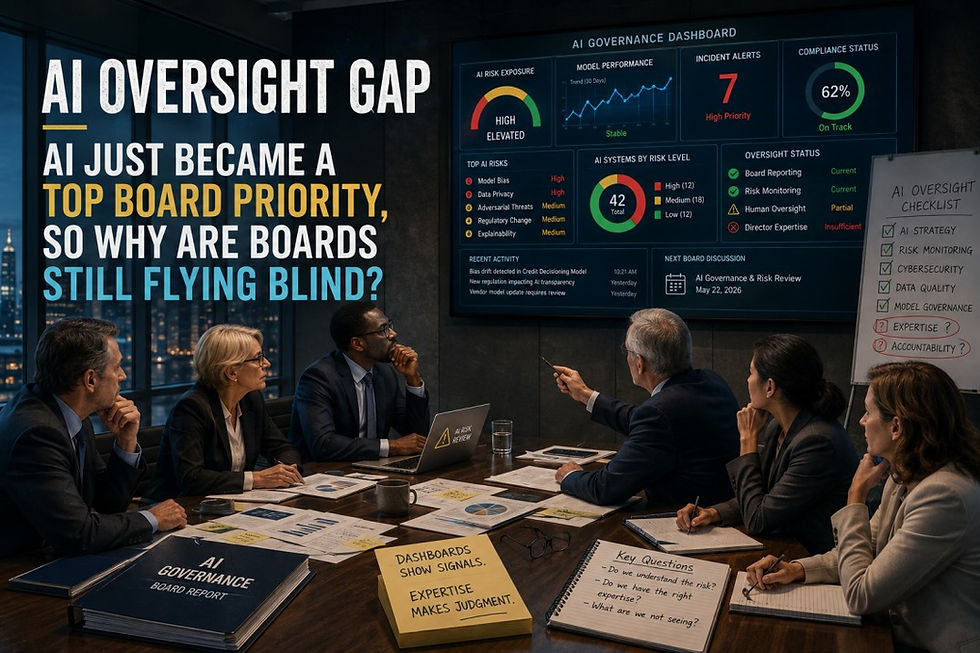
There's a specific kind of governance gap that doesn't show up until someone actually asks the awkward question out loud: not "does your board discuss AI," but "if your AI-powered dashboard flagged something dangerous right now, is there a written policy telling anyone what happens next?" A lot of boards, when they actually sit with that question, don't love their own answer.
I covered the AI expertise gap in a companion piece already, the fact that a striking share of directors admit they don't feel equipped to oversee AI. This one's about a different, arguably more fixable problem: even boards that do have AI-literate people in the room often don't have the actual paperwork, the charter, the escalation path, the named accountable owner that turns individual expertise into an institutional safeguard. Expertise without policy is a smart person improvising. Policy without expertise is a document nobody can act on. 2026's data suggests a lot of boards are stuck with one or the other, rarely both.
This post digs into what a real AI governance policy is supposed to contain, how few companies actually have one on paper despite having AI-savvy people at the table, and why regulators and courts are starting to treat "no policy" as a distinct legal exposure from "no expertise."

Quick Answer Section
What is an AI governance charter?
A formal document defining who's accountable for AI oversight, what decisions require board or committee approval, how incidents get escalated, and what human review is required before high-impact AI decisions go live.
How many companies actually have one?
Not many, relative to how many discuss AI. Analysis of over 3,000 companies found only 16% disclosed even a single AI-skilled board director, and formal AI policy disclosure trails even further behind that.
Is having an AI-skilled director the same as having AI governance?
No, and this is the core finding worth sitting with: research shows plenty of boards with AI-fluent directors still lack the standardized written policy needed to turn that individual skill into an institutional safeguard.
Why does the gap between expertise and policy matter legally?
Because courts and regulators, drawing on precedents like Delaware's Caremark standard, increasingly judge boards not on whether AI failed, but on whether reasonable oversight structures existed before it did.
Who should be worried about this specific gap?
Any board that's confident in its AI knowledge but hasn't formalized who owns AI decisions, how incidents escalate, or what gets documented along the way.
Why "We Have Smart People Watching This" Isn't a Policy
Boards tend to conflate two very different things: having someone in the room who understands AI, and having a documented system for how AI decisions actually get made, reviewed, and escalated. The first is a personnel question. The second is a governance question. Confusing them is exactly how a genuinely AI-literate board still ends up with no defensible paper trail when something goes wrong.
Analysis of governance disclosures across more than 3,000 companies found that only 16% disclosed having even one board director with specialized AI skills, and of that already-small group, only about 4% had moved beyond a single "lone expert" to seat two or more AI-skilled directors. That scarcity alone is notable. What's more revealing is what happened when researchers checked whether AI-skilled boards actually had formal AI policies and procedures documented alongside that expertise. The presence of an AI-fluent director turned out not to reliably predict the presence of an actual written policy. Plenty of "AI-fluent" boards, in other words, are operating on individual judgment rather than institutionalized process, exactly the setup that looks fine right up until the person with the expertise is out of the room, or out of the company, when a decision needs to get made.
AI Governance Committee vs AI Governance Structure
Advisory Committee | Governance Structure |
Makes recommendations | Has defined decision rights |
May lack authority | Has documented authority |
Can be overridden easily | Can enforce defined controls |
Often discussion-focused | Accountability-focused |
May lack escalation powers | Has escalation authority |
A committee is not automatically a governance structure simply because it has a charter.
The Disclosure Numbers Are Even Thinner Than They Look
Widen the lens beyond AI-skilled directors specifically, and the picture doesn't improve. In 2025, roughly a quarter of S&P 500 companies disclosed formal frameworks or policies around AI, while companies in the broader Russell 3000 index lagged dramatically behind, in the single digits. Board-level oversight disclosure followed almost the same pattern, a modest share of large-cap companies disclosing it, a much smaller sliver of the broader market doing the same. And AI skill itself, where it exists at all, is heavily concentrated: five sectors account for the large majority of all AI-skilled board seats, meaning governance maturity right now is less an industry-wide standard and more a handful of tech-adjacent sectors pulling the average up while most of the market sits well behind.
Put plainly: the median public company in 2026 likely has neither a documented AI policy nor a board member equipped to build one quickly if asked. That's not a hypothetical risk. It's closer to a baseline description of where most boards currently stand.
What an Actual AI Governance Policy Is Supposed to Contain
This is where a lot of boards get stuck, because "AI policy" sounds abstract until you break down what it's actually supposed to specify. Governance practitioners working on this in 2026 generally converge on a few concrete components. A named executive AI owner, usually someone at the CIO, CTO, or CDO level, or a specifically designated delegate, who holds enterprise-wide accountability for how AI policy gets adopted and enforced, rather than accountability sitting diffusely across whichever team happens to be using a given tool. Risk tiering and intake, meaning every new AI use case gets classified by risk level and assigned a named business owner before it launches, not after someone notices it's already running. Defined human oversight, a rule that no high-impact decision relies on AI output alone, with a trained human able to inspect, override, or halt the system when results look unreliable. And an escalation path with actual teeth, clear triggers for when an issue gets kicked up to the board or a designated risk committee, tested in advance rather than improvised the first time it's actually needed.
Notice what's genuinely absent from a proper policy compared to what a lot of boards currently have: an informal working group that meets occasionally with no charter, no defined decision rights, and no clear line to the board isn't a governance structure, it's a conversation. One recent governance framework put this distinction bluntly: a body with nine members, external advisors, and a published charter, but no actual veto power over a risky deployment, is "an advisory committee with elaborate decoration." A five-person body with real authority to block a deployment is a governance structure, regardless of how much smaller or less impressive it looks on paper.
Why Regulators and Courts Are Starting to Care About This Specific Distinction
The legal reasoning behind why this gap matters draws a direct line to how Delaware courts have historically approached board oversight failures more broadly, under what's known as the Caremark standard. Directors generally aren't held personally liable simply because something under their watch went wrong. They're held liable for failing to put reasonable oversight systems in place to catch it. Applied to AI, that means a board isn't necessarily exposed just because an AI system produced a bad outcome. It becomes exposed when it can't show a documented framework existed, regular reporting happened, and oversight activity was actually recorded, the kind of defensible paper trail that demonstrates the board did its job, independent of whether the underlying AI performed perfectly.
That's precisely why the expertise-without-policy pattern is such an uncomfortable combination. A board can have genuinely capable people making sound judgment calls in real time and still fail this specific legal test, because the test isn't "did smart people make good decisions." It's "can you show us the system that was supposed to catch bad ones."
A Boardroom Perspective
The instinct to hire or recruit for AI expertise is a reasonable one, but it solves only half the actual problem. A board with a brilliant AI-literate director and no charter is one resignation away from having no institutional memory of how AI decisions were ever supposed to be made. The dashboard tells you what's happening. The policy is supposed to tell everyone, consistently, what happens next, regardless of who happens to be in the room that day.
Four Steps to Close the AI Governance Policy Gap
Four concrete steps that don't require waiting on a broader AI literacy program to finish first:
Write the charter before adding more experts. A documented framework that a moderately AI-literate board can follow beats an undocumented process only a genius could execute.
Name one accountable owner, not a rotating committee. Diffuse accountability across "whoever's using the tool that week" collapses the moment something actually goes wrong.
Test the escalation path before you need it. A tabletop exercise, walking through a hypothetical AI incident end to end, exposes gaps in minutes that would otherwise surface during an actual crisis.
Treat documentation as the deliverable, not a side effect. Meeting minutes, review records, and incident logs are what turns "we discussed AI" into a defensible governance record later.
Real-World Example
A mid-sized retail company formed what it called an AI ethics committee in early 2025, nine members, a published charter, quarterly meetings, external advisors brought in for credibility. On paper, it looked like exactly the kind of governance structure regulators want to see. When a customer-facing AI tool started generating pricing recommendations that disproportionately disadvantaged a specific customer segment, the committee reviewed the issue, expressed concern, and recommended the system be paused. Business leadership, under pressure to hit a quarterly sales target, overrode the recommendation and kept the tool running for another six weeks before finally pulling it after a public complaint.
Nothing about the committee's charter had actually given it the authority to stop the deployment. It could recommend. It couldn't require. That distinction, invisible on the org chart, turned out to be the entire ballgame. The company had built what looked, in every disclosure and press mention, like real AI governance. What it had actually built was an advisory body with no enforcement power, discovered only at the exact moment enforcement power was needed.
FAQs
Why is an AI governance policy important?
An AI governance policy turns individual AI expertise into an institutional process by defining accountability, risk controls, human oversight, escalation procedures and documentation requirements.
Is having an AI-skilled board member enough to satisfy governance expectations?
Not on its own. Research shows individual AI expertise on a board doesn't reliably correlate with the presence of formal, documented AI policies, which is what regulators and courts actually look for.
How common is formal AI policy disclosure right now?
Still limited. Roughly a quarter of S&P 500 companies disclosed formal AI frameworks or policies in 2025, with much lower disclosure rates across the broader market.
Why would a board be liable even if its AI system worked fine most of the time?
Under governance standards like Delaware's Caremark doctrine, liability tends to attach to the absence of reasonable oversight systems, not solely to bad outcomes, meaning a lack of documented process is itself the exposure.
What's the fastest way for a board to close this gap?
Formalizing a charter with a named accountable owner, defined escalation triggers, and documented reporting tends to close more real risk, faster, than waiting to recruit additional AI-expert directors.
What's the difference between an advisory AI committee and a real governance structure?
Authority. An advisory committee can recommend actions but can be overridden. A functional governance body has actual veto power over risky deployments, documented in its charter.
Is an AI-skilled director enough for AI governance?
No. An AI-skilled director can provide expertise, but effective governance also requires documented policies, clear accountability, defined decision rights and an escalation process.
What should an AI governance policy include?
A strong AI governance policy should address:
Accountability
AI risk classification
Human oversight
Approval requirements
Incident escalation
Documentation
Monitoring
Board reporting
Key Insights
Only about 16% of a large sample of companies disclosed even one AI-skilled board director, and just 4% had more than one, concentrated heavily in a handful of sectors.
Having AI-literate directors doesn't reliably predict having a formal, written AI policy, the two gaps don't close together automatically.
A properly built AI governance charter names an accountable owner, defines risk tiers, requires human oversight, and sets tested escalation paths.
Legal standards like Delaware's Caremark doctrine increasingly judge boards on the existence of oversight systems, not just outcomes.
An advisory committee without real veto power over deployments is governance theater, regardless of how credible it looks on paper.
Key Takeaways
Expertise and policy are two separate gaps, and 2026's data makes clear that closing one doesn't automatically close the other. A board can recruit the most AI-literate director available and still be exposed if there's no charter, no named accountable owner, and no tested escalation path behind that person's judgment. The boards actually reducing their risk this year aren't necessarily the ones with the most impressive-sounding AI ethics committee. They're the ones that can produce, on request, the actual document that says who decides, what triggers a stop, and what happens the next time smart people in the room disagree with each other.
Directors’ Institute – World Council of Directors can help you strengthen your board journey by developing your understanding of director roles, responsibilities, corporate governance, and effective boardroom leadership.
Join our exclusive webinar: Directors-Institute-webinar-registration


Comments